by Rajnish Singh, European Policy Centre
As much of the Brussels bubble spends this week fixated on Ursula von der Leyen’s State of the European Union speech in Strasbourg and the future of Europe, another gathering may ultimately prove more important for the future balance of global power.
On 12-13 September, leaders from the Global South gathered in New Delhi, India, for the 18th BRICS Summit. The timing was striking. Canadian Prime Minister Mark Carney is in Europe for political discussions with his counterparts, including EU leaders. It highlights an uncomfortable reality: the transatlantic alliance is under growing strain, especially as US President Donald Trump continues to pursue a more confrontational trade policy, threatens to withdraw security guarantees, and continues his war with Iran.
At precisely the moment Western unity looks increasingly fragile, BRICS is presenting itself as an alternative pole of geostrategic influence.
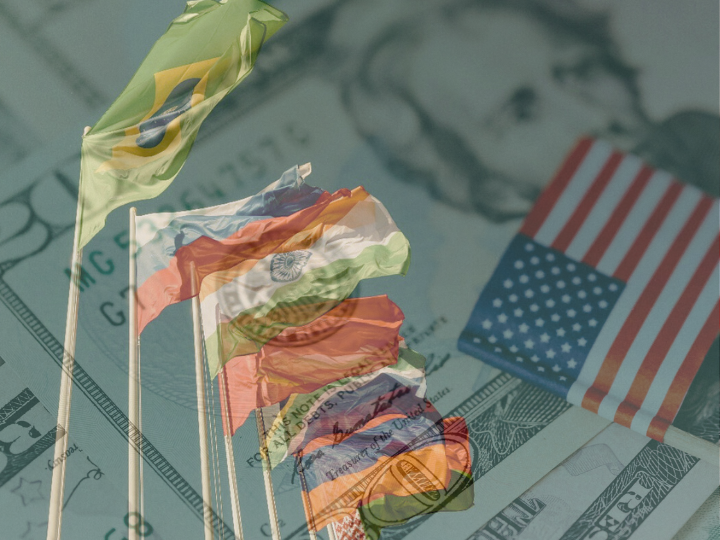
The summit brought together the bloc’s 11 full members: Brazil, Russia, India, China, South Africa, Egypt, Ethiopia, Iran, Saudi Arabia, the United Arab Emirates and Indonesia. Together, they account for roughly half of the world’s population, around 40% of global GDP and about 26% of global trade.
Just as importantly, BRICS has expanded beyond its original membership through partner countries and the BRICS Plus format, allowing dozens of emerging economies to engage with a platform that increasingly claims to speak for developing nations. The real story, however, was the New Delhi Declaration itself.
At 140 paragraphs and 45 pages, the declaration reads less like a traditional summit communiqué and more like a blueprint for an alternative system of global governance. It covers UN Security Council reform, IMF and World Bank restructuring, trade, payment systems, artificial intelligence, development finance, energy security, climate policy, food security, terrorism and conflict resolution.
Compare that with recent G7 communications, which are often broken up into a series of narrowly focused declarations. The contrast is revealing. BRICS is attempting to project itself as a comprehensive forum for advancing the interests of emerging economies, while the G7 increasingly appears constrained by internal divisions and concerns about provoking Trump.
Yet it would be premature to declare BRICS the dominant force in global affairs.
The bloc remains deeply divided. The summit itself saw Indian Prime Minister Narendra Modi and Chinese leader Xi Jinping seek to continue a cautious reset in relations after years of tensions stemming from their disputed Himalayan border. Both sides emphasised the need for peace and stability, yet profound mistrust remains.
India also remains wary of Chinese dominance within BRICS. Beijing now accounts for roughly three-fifths of the expanded bloc’s combined GDP, making BRICS increasingly susceptible to the same imbalance that characterises the G7’s dependence on the US economy.
Neither has New Delhi forgotten that Beijing remains Pakistan’s principal strategic backer, supplying advanced military technology and sustaining major economic investments. Meanwhile, Russia, long India’s most important defence partner, is becoming increasingly economically dependent on China as the war in Ukraine drags on. These realities limit how far BRICS can evolve into a genuinely unified geopolitical actor.
Nevertheless, the New Delhi summit demonstrated something important: for many countries across Asia, Africa, the Middle East and Latin America, BRICS increasingly represents opportunity, influence and representation in a way that Western-led institutions often no longer do.
Today, the G7 still possesses greater military power, deeper financial markets and stronger institutional cohesion. But history rarely rewards complacency. If Trump continues to alienate allies, if transatlantic divisions widen, and if Europe remains constrained by ageing populations and sluggish growth while BRICS members continue to expand economically, the balance could gradually shift.
The significance of New Delhi is not that BRICS has already overtaken the G7.
It is that, for the first time, such a possibility no longer seems implausible.
 By: N. Peter Kramer