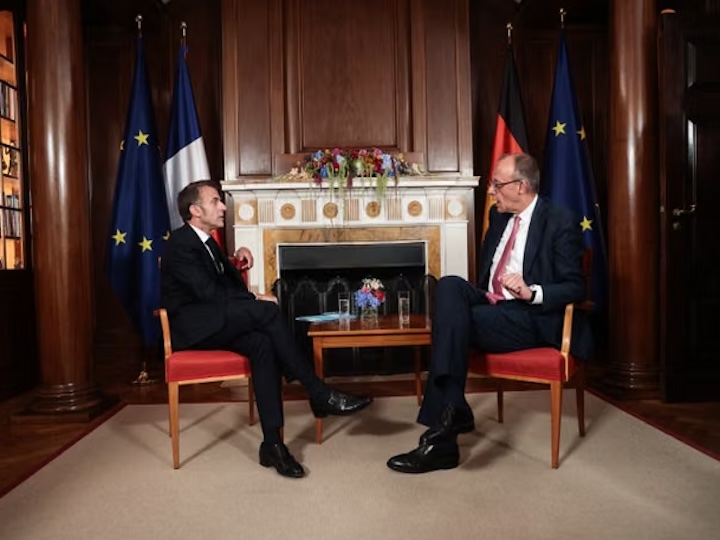
In the event of a new trade war, the EU must be able to swiftly and completely exclude unfair trading partners from the European single market. This is what German Chancellor Friedrich Merz and French President Emmanuel Macron are jointly advocating in a remarkable letter to Ursula von der Leyen, President of the European Commission.
They argue that if the EU comes under economic attack in the form of trade tariffs or economic sanctions, Brussels must be able to strike back just as swiftly and forcefully. Countermeasures could even lead to the immediate exclusion of companies from the European market or – if necessary – even entire countries within a matter of days.
1 billion euros a day
With their proposals, Merz and Macron aim to prevent individual Member States from blocking a swift European response when major powers such as China or the United States exert economic pressure. According to the two heads of government, the existing European trade instruments are too slow, too complex and too dependent on decision-making by the Member States. The European anti-coercion instrument – also known in Brussels as the ‘bazooka’ – requires a qualified majority to determine that a trading partner is guilty of ‘economic coercion’.
Although the letter does not name any countries, German sources suggest the EU is focusing primarily on China. The European trade deficit with China already stood at around 1 billion euros a day at the end of last year and is set to rise further in 2026.
Unfair competition
China has become the world’s largest exporting power. Products that Chinese companies find it harder to sell on the US market are increasingly finding their way to other parts of the world. Due to state aid and overcapacity, many Chinese goods are entering the international market at very low prices, which, according to critics, distorts competition and puts European industries under dangerous pressure. According to some estimates, this could cost European industry millions of jobs in the long term.
Incidentally, the new instrument could be used against more than just China. Russia or the US could also come under scrutiny. Donald Trump has already put pressure on Europe on several occasions in the past through economic measures. Merz and Macron therefore want the EU to be able to retaliate swiftly and in kind against any trading partner that Brussels deems to be behaving unfairly.
Last resort
Whether it will actually come to that remains to be seen. Excluding a country is, in any case, a last resort. According to senior German officials quoted by the business newspaper *Handelsblatt*, Merz and Macron’s new European trade weapon is primarily intended as a deterrent. A European economic ‘kill switch’, they argue, would be so far-reaching that the threat alone could force countries such as China or the US to the negotiating table. Just as was the case with the nuclear threat during the Cold War.
The timing of the Franco-German letter is also striking. The European Commission has been working for months on new economic protection measures and is currently preparing protective import tariffs against Chinese hybrid cars.
Diversifying supply chains
In Berlin, Brussels and Paris, there is growing concern that China could respond to this with export restrictions on critical minerals on which many European companies are heavily dependent. The German-French proposal aims to prevent such a trade conflict from escalating further and to prepare European companies for such a worst-case scenario. Merz and Macron also propose that European companies diversify their vulnerable supply chains more quickly. In this way, they should become less dependent on rival countries such as China or the US for their production.
But we are not there yet. The support from Germany and France does, however, lend extra weight to the idea ahead of next week’s European summit, where Merz and Macron’s joint proposal will undoubtedly be discussed. For European Trade Commissioner Maros Sefcovic, too, the strong language in the letter comes at a crucial moment. He is travelling to China at the end of this week to gauge the state of bilateral trade relations.
*Published first on De Standaard
 By: N. Peter Kramer