by
Sinan Ulgen*
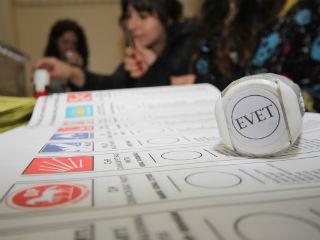
Τhis weekend, Turks will cast their votes to determine the identity of the country’s first executive president and the setup of a new parliament.
For more than a decade—to paraphrase Gary Lineker’s famous quote about football and Germany—Turkey’s elections were a contest that unavoidably ended with an Erdogan win. Yet this time around, the result is far from being a foregone conclusion. On the contrary, many different outcomes are possible.
The dominant scenario at present is an Erdogan win for president, possibly in a second-round runoff that will be held two weeks after the June 24 vote, and a split parliament, in which the ruling AK Party (the AKP) would have lost its majority.
This “co-habitation” scenario will be a novel phenomenon for Turkish politics. Many fear that the outcome would lead to a systemic bottleneck, triggering new elections.
But the counter argument is that the president will have an incentive under these circumstances to find a modus vivendi with a parliament that he doesn’t control. Even though Erdogan is not particularly known for his consensual style of leadership, he will not be inclined to risk losing one term by going to early elections. So somewhat surprisingly, a political system that is designed for majoritarianism could lead to a more consensus-driven political culture.
The critical threshold for Erdogan in the first round of the presidential elections is around 47 percent, which is where most current polls place him. If he ends up receiving more than 47 percent of the vote in the first round, he is most likely to win the second round.
But below this threshold, the outcome becomes much less certain, with improved prospects for the opposition candidate—in all likelihood Muharrem Ince, the candidate of the main opposition Cumhuriyet Halk Partisi (CHP).
As a result of his identity politics and polarizing tactics, Erdogan has in essence been able to consolidate a substantially large but marginally insufficient share of the national vote. His style of politics and campaign performance have been sufficient to win under a parliamentary system.
But now the shift to a presidential system compels candidates to get 50 percent-plus-one of the national vote. This is where the ongoing climate of political polarization becomes a hindrance. While it helps to cement support within Erdogan’s more natural constituency, it creates a possibly non-bridgeable gap with the rest of the Turkish polity. That will be Erdogan’s dilemma in a second-round vote.
The task of the opposition candidate will be equally difficult.
After having secured quite possibly somewhere near 30 percent of the national vote, Muharrem Ince will need to aggregate the votes of the whole opposition in the second round. His challenge will be to convince the nationalist base of the IYI Party. He may well propose the IYI Party’s chairwoman, Meral Aksener, to join his presidential ticket. He may also set up a more inclusive shadow presidential cabinet that reflects the pluralism of the political opposition.
The second likely scenario is an outright win for Erdogan and his ruling AK Party. The concern about this outcome is a severe weakening of any remaining checks and balances to executive authority, ultimately leading to a further erosion of Turkey’s democratic credentials. Yet Turkish voters may be moved by an argument of political stability with a parliamentary majority fully in line with presidential authority.
Finally, the third and least likely scenario is an outright win by the opposition for both the presidency and parliament—tantamount to an overhaul of the political constellation of power established over the past sixteen years.
That is a scenario with a vastly richer set of implications for Turkey’s domestic and foreign policies.
The opposition alliance has, for instance, promised the lifting of the emergency rule, the strengthening of the rule of law and fundamental freedoms, a reform of the judiciary, and a return to parliamentary democracy.
On foreign policy, a new leadership is likely to adopt a more pro-Western rhetoric, backed by its pro-reform agenda at home. Any lasting improvements in Turkey’s relationship with its partners in the West would, however, be conditional on a higher degree of receptiveness to Ankara’s justifiable demands for a more effective Western cooperation to address its national security and economic policy related challenges.
The stakes are indeed very high.
*Visiting Scholar, Carnegie Europe
**First published in carnegieeurope.eu
 By: N. Peter Kramer