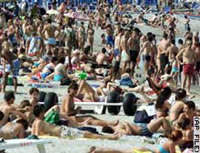
Italy stated it faced a "national emergency" as over-development was causing its beaches to shrink at an alarming rate, posing a threat both to nature and to the country's huge holiday trade.
"There is no doubt that there is a real national emergency, a serious problem for Italy where 60 percent of tourism is on the coast," Environment Minister Altero Matteoli told a conference on coastal erosion.
With an annual tourism income of more than 150 billion euros ($195 billion), or more than 10 percent of GDP, Italy has an interest in protecting its natural assets. But the very attraction of the seaside may be leading to its downfall.
Construction, often of holiday homes which have sprung up in huge numbers in recent decades, meant a 26 percent increase in built-up coast between 1975 and 1990, according to European Union data, and that has had a knock-on effect on beaches.
Seawalls and harbours, land reclamation and dredging can all have a long-term impact on the flow of sediments which make and maintain beeches. Such man-made impacts cause more problems than natural erosion, according to the EU's Eurosion report.
Europe loses 15 square km of beach a year due to erosion, the report said.
Italy, with 7,600 km (4,700 miles) of coastline, is one of the hardest-hit countries and an Italian group told Wednesday's conference that 4 square km of local beaches had vanished "in recent years."
But while the causes of beach erosion are well known, possible solutions are hotly disputed.
For the hosts of the Rome conference, a company called Eurobuilding, the answer lies in "beach nourishment," taking sand from the seabed and dumping it onto depleted beaches.
A major project of that type converted Miami beach in the 1970s from a mere strip of sand to a broad sandy playground and world famous tourist attraction, speakers at the conference said, adding similar schemes could boost Italian tourism.
But Italian ecologists say such activities usually do more harm than good and they have protested against recent efforts to use the method to beef up the seaside near Rome.
"Beach nourishment is a catastrophe for the seabed," said Paolo Guglielmi, of the conservation group WWF (formerly the World Wildlife Fund). Sea life is damaged and the newly created beach is often washed away in a few years, he said.
Instead of such industrial-scale intervention, developers should ensure they do not destroy silt flows that create beaches, Guglielmi said.
"To make tourism more sustainable is more important than beach nourishment. It means trying to find a natural balance."
 By: N. Peter Kramer