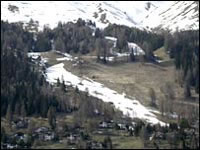
The impacts of ski piste preparation on alpine plants are long-lasting and greatest at higher altitudes, Swiss researchers report.
The effects are likely to worsen as global warming forces ski operators to use more artificial snow and open higher runs, the scientists say.
They compared the vegetation on and off-piste at 12 Swiss ski resorts, in the biggest study of its kind.
Overall, they found 9% less plant cover and 11% fewer plant species on-piste.
Woody plants and early-flowering species were seen to be worst-affected.
These differences were more pronounced at higher altitudes, suggesting greater future impacts as skifields move upwards.
The work was undertaken by a team from the Swiss Federal Institute for Snow and Avalanche Research (SLF), the University of Zurich and the University of Potsdam in Germany.
It has been published online in the Journal of Applied Ecology.
Artificial snow
Damage caused by grading machines, used to smooth out underlying rock and soil, was particularly severe, the team found.
Machine-graded pistes had five times more bare ground than ungraded pistes and had not fully recovered 30 years after grading, even on slopes that had been re-sown.
"At higher altitudes, especially above timberline, it's really difficult to re-vegetate areas that have been graded," SLF botanist Christian Rixen told the BBC News website. "The higher you are, the more difficult it is."
Because it lies longer than natural snow, artificial snow favoured snowbed plants such as the alpine snowbell (Soldanella alpine) and later-flowering species such as heather (Calluna vulgaris) over gentians and other early-flowerers.
These shifts in species composition became more prominent the longer snowmakers had been used.
Wider impacts
Such changes in vegetation are likely to have wider impacts, the researchers report.
Decreasing the plant cover on ski slopes could make the soil more prone to erosion and reduce their value to summer users, including farmers and hikers, said Dr Rixen.
His team recommended that extensive machine-grading and artificial snow-making be avoided and that ski pistes should not be established in areas of high conservation value.
"The effects we found will be a lot more dramatic in coming years," warned Dr Rixen, because artificial snow production is increasing and ski runs are being developed at higher altitudes, where the vegetation and soils are more sensitive.
The level of reliable snow is predicted to rise by 300-600m in Switzerland over the next 30-50 years because of global warming, according to a United Nations Environment Programme report.
Already, the lower countries such as Austria and Italy use artificial snow on about 40% of ski runs and the figure, though lower, was rising rapidly in Switzerland, said Dr Rixen.
 By: N. Peter Kramer