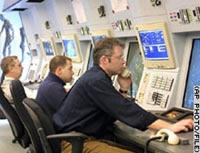
The European Union unveiled an ambitious plan for a 20 billion euro ($23.4 billion) air traffic management system to help Europe cope with an expected doubling in the number of flights over the next 15 years.
Dubbed "Sesar," the plan aims to make flights safer, less polluting and easier for air traffic controllers to monitor.
European air routes would gradually be reorganized over the next 15 years so that air space and traffic flows are managed through state-of-the-art technologies, EU spokesman Stefaan Rynck said Wednesday.
"In the 1980s and '90s, Europe was caught by surprise by air traffic growth," Victor Aguado, director general of the flight safety organization Eurocontrol, told a press conference Thursday. "We need to anticipate the future and launch our initiatives well in advance."
Sesar's startup phase, which would run through 2007, is budgeted to cost 60 million euros ($70 million) and provide jobs for 200 people. The subsequent "validation and deployment" phases -- running from 2008 to 2020 -- would cost about 300 million euros ($350 million) a year, Rynck said.
The funding for Sesar will come from the EU's long-term science and research budget. It does not need to be approved by EU governments. The plan was initially dubbed Sesame, but that was recently changed for legal reasons, officials said.
The EU estimates Sesar's economic trickle-down effect to total some 60 billion euros ($70 billion) and generate an estimated 200,000 jobs, while cutting down on airplane noise and pollution and stepping up safety.
European Commission Vice President Jacques Barrot said he will propose in the next few weeks that the EU's head office attach Galileo -- the continent's satellite navigation program -- to the air traffic scheme.
Galileo technology "will give freedom to aircraft to follow routes which are less rigid" and give "more autonomy" for airplanes flying over places like Africa, where air traffic controllers are less accustomed to directing flights, Barrot said.
Europe's aviation industry has long complained that, in an age of broadband communications, air traffic management still relies on technologies that can be 50 years old while traffic has more than doubled since then.
Ground-to-air traffic control communication still is done on congested VHF radio frequencies, and air routes are organized according to ground-based, 1950s-era navigation devices.
Also, Europe's air traffic control operations are divided along national boundaries.
"Virtually no automation has been introduced in air traffic management decision-making, which puts a particularly heavy pressure on the shoulders of air traffic controllers," says a recent EU report on the state of the aviation industry in Europe.
"We have been complaining about the present system for a long time and now we have been forced to do something about it," said Olaf Dlugi, chairman of the Sesar Consortium, which comprises 30 major European air transport companies and associations.
He said the new plan will collaborate with American air management organizations and that the American aviation companies Boeing Co., Honeywell International Inc. and Rockwell Collins Inc. have indicated they would like to be involved in the project.
The Sesar program will bring together EU governments, airports, airlines and air navigation service providers and Eurocontrol, the European organization for the safety of air navigation.
 By: N. Peter Kramer