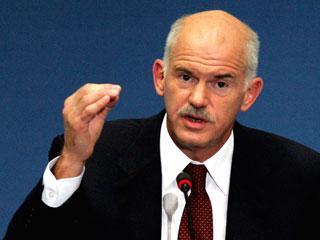
Addressing a meeting of social partners, workers' and employers' unions, government ministers and representatives of economic and social groups, at the Zappeion Hall, the Greek premier said the government has the will to take bold actions and urged for consensus with Greek citizens, saying that international confidence on the economy will be strongly and rapidly restored if both the government and citizens agreed to move forward to change the country.
Papandreou presented the main goals of a government reform plan, saying that a dialogue with social partners must have been completed by early next year (end of February), so that the government could begin implementing its new policy.
The premier stressed that the country needed a new social deal. "We must change or sink," he said. He noted that the new PASOK government must take in the next three months decisions not taken in decades by previous governments.
The government will begin a fiscal consolidation plan with its 2010 state budget, Papandreou said and pledged that the fiscal deficit will be brought below 3.0% of the country's Gross Domestic Product in 2013. This will be achieved through the implementation of structural and permanent measures, the premier said and noted that the country's public debt would begin falling from 2012 at the latest.
Papandreou presented a package of measures aimed at cutting the fiscal deficit, including lower operating spending by the state (decrease by 10% of operating costs), freezing new hirings in the public sector for 2010 -with the exception of education, health and social insurance sectors-, closing all press offices abroad (which will be absorbed by Greek embassies), closing one third of the national tourism organisation's (EOT) offices abroad, offering pay rises at the inflation rate, cutting spending on pay benefits in the public sector by 10 pct, introducing a single payment authority in the public sector by mid-2010 and reducing arms supply programs in 2011 and 2012.
Papandreou also announced a reduction in executive pays in public sector enterprises, freezing bonuses to high-ranking bank executives controlled by the state and taxing private banks' executives' bonuses with a 90 pct tax rate.
He said that a reform of the development law would be implemented in the first three months of 2010, aiming at creating new jobs, supporting export activity and Green Development.
Papandreou also announced bold changes in the public procurement program and in pharmaceutical supplies to state hospitals and noted that all ministries' spending would be reassessed from zero base. He pledged full transparency in the execution on state budgets.
The prime minister also said that drastic measures were being taken in the fight against economic crime and tax evasion while promising a radical change in the way ecomomic immigrants are treated in the country.
He also said that a reform of the electoral law would offer the possibility of cutting down election campaign expenditures and "black money", announcing that the new electoral law would be implemented in next year's local government elections.
 By: N. Peter Kramer