by Simon Torkington*
Until recently, there was, however, one fairly solid assumption: creative jobs would be safe from automation.
The sudden arrival of generative AI has changed everything - or at least that’s how it feels to millions of people working in the creative industries. In a matter of a few months, writers, designers, photographers and filmmakers, among others, have had their futures opened up to speculation.
It wasn’t supposed to be like this. Then along came ChatGPT, DALL-E and MidJourney - and suddenly our social media feeds were filled with content that had no human input beyond a text prompt telling the AI what to create.
Much of the public discourse around generative AI and creative jobs has focused on the potential threats – but researchers are pointing out that this technology also brings opportunities in terms of enhanced productivity, efficiency and profits.
The potential impact of generative AI was a major focus at the World Economic Forum’s Growth Summit 2023, held in Geneva earlier this month.
How will generative AI disrupt the creative industries?
The current versions of generative platforms are in their infancy, with many still in beta trial mode. What is certain is they’ll become more capable at an exponential rate and that will raise the potential for disruption in the creative and many other industries.
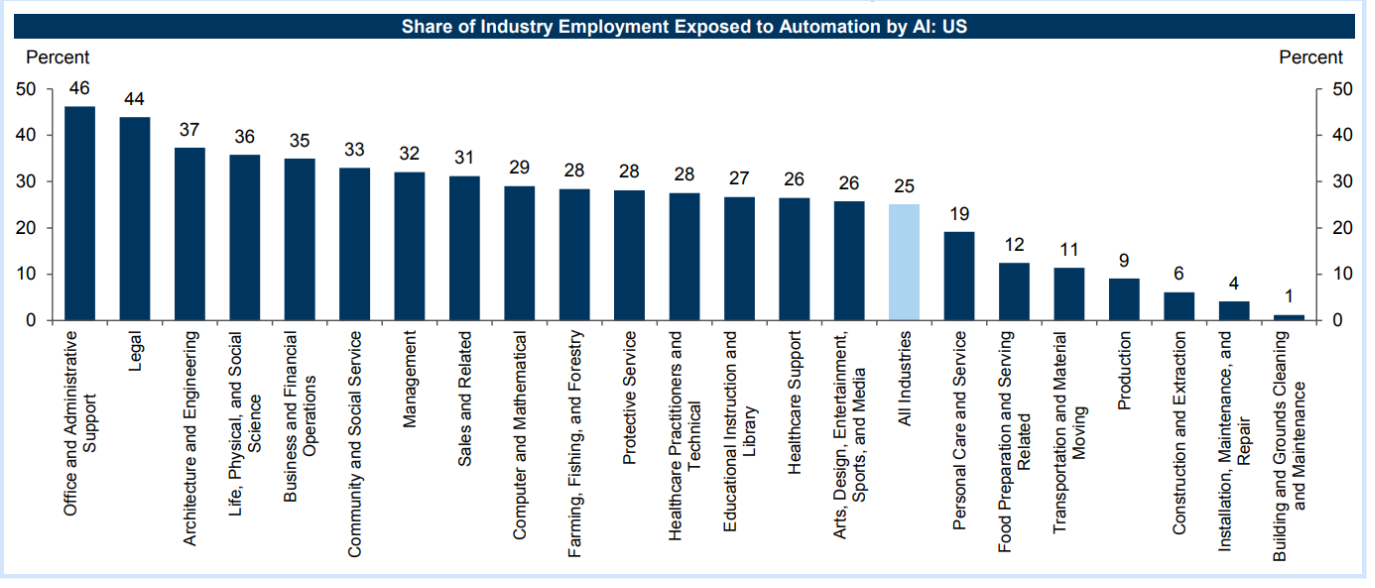
Research from Goldman Sachs suggests that generative AI has the potential to automate 26% of work tasks in the arts, design, entertainment, media and sports sectors.
The Harvard Business Review reports that generative AI already has advanced capabilities across a broad range of creative content used in the marketing industry. The report says a refined version of GPT-3 called Jasper “can produce blogs, social media posts, web copy, sales emails, ads and other types of customer-facing content”. The report states that major food manufacturers, including Heinz and Nestle, have already used AI-generated content in advertising campaigns.
When Heinz asked DALL-E 2 to create versions of ketchup bottles in a series of artistic styles, the company noted that the AI largely recreated its own distinctively shaped bottle to represent the product. It ran with the idea to produce a video campaign ad – and so one of the world’s first AI-generated advertising campaigns was born.
How can AI add value in creative industries?
The fact that generative AI only emerged for public use a few months ago means many companies are only beginning the process of understanding how it can be used to add value.
Management Consultancy McKinsey & Company took a close look at the fashion industry to test how it might be applied in one creative sector. McKinsey sees use cases across fashion that go well beyond the automation of tasks. The researchers identified opportunities in product development and innovation, marketing, sales and customer experience. As well as speeding up laborious tasks, generative AI can analyse seemingly unconnected data to deliver new insights that can add value across creative organizations.
The report urges industry leaders to “make value your North Star” as they begin the generative AI journey. This means identifying the areas that can benefit the most from AI as a matter of priority, and then developing use cases and long-term goals based on the integration of generative AI into the business, says McKinsey.
Managing the risks of generative AI
There’s no doubt that generative AI will bring a range of opportunities, but this technology also brings risks that must be carefully managed. One major concern is that proprietary information and data used in prompts on generative AI tools are stored on the servers of AI companies. This risks the same information being served in response to future prompts, creating the threat of confidential data, content or designs entering the public domain. TechRadar reports that Samsung lost control of valuable source code and confidential meeting notes when staff included them in a ChatGPT prompt.
Another issue with generative AI arose at the Guardian newspaper in the UK, where it was discovered that ChatGPT had manufactured articles and added the names of the paper’s writers, suggesting they were genuine Guardian reports. The issue only came to light when a member of the public enquired about an article she had seen on ChatGPT, only to find it had never existed.
For creative industries, generative AI will bring a range of rewards – but only if sophisticated guardrails are put in place to protect original content and designs.
*Senior Writer, Forum Agenda
**first published in: Weforum.org
 By: N. Peter Kramer