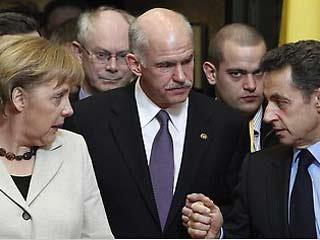
"There is an agreement on the Greek situation. We will communicate now the agreement to the other leaders," Van Rompuy told reporters gathered at the EU leaders' summit. The agreement was forged in talks between Van Rompuy, European Commission President José Manuel Barroso, French President Nicolas Sarkozy, German Chancellor Angela Merkel, European Central Bank President Jean-Claude Trichet and Greek Prime Minister George Papandreou.
Polish Prime Minister Donald Tusk told reporters earlier that the aid, which would amount to the first bailout of a eurozone member since the currency was created 11 years ago, was likely to come in the form of loans.
"It could be voluntary loans from member states. That seems to be the best option," Tusk said.
A Spanish source told Reuters that details of the aid would be worked out at the latest by Tuesday, when EU finance ministers are due to hold a meeting. "The general idea is to have broad European assistance with a tighter focus of assistance by eurozone countries," the source said, requesting anonymity. The European Commission would have a supervisory role over the aid deal.
Tough steps
European leaders are keen to prevent Greece's woes from spreading to other highly-indebted eurozone members like Portugal or Spain, plunging the currency area into a bigger crisis that could reverberate around the globe.
But until this week, they have avoided speaking openly about the aid, fearful that might ease pressure on the government in Athens to enact tough austerity measures needed to bring down a deficit that soared to 12.7% of gross domestic product (GDP) last year - more than four times EU limits.
The euro jumped versus the dollar after Van Rompuy announced the deal. The premium investors demand to hold Greek government bonds rather than benchmark Bunds tightened 10 basis points on the news to 266 basis points, 17 basis points tighter on the day. But markets remain wary amid uncertainty over the terms of the aid for Greece and how it might affect investor sentiment towards the 16-nation euro zone.
Even with EU support, the Greek government faces a daunting challenge to consolidate its budget and restore confidence in an economy whose imbalances were exacerbated by the economic and financial crises. Greek public sector union ADEDY said on Thursday it would join in a 24 February strike called by private sector union GSEE to protest government austerity measures, underscoring the risk that social unrest could hamper the Greek consolidation drive.
Germany and France expected to take the lead
Germany and France were expected to take the lead in support as Italy and Spain - the other two big economies in the euro zone - are themselves under financial pressure. Various options have been under discussion, including Germany buying Greek government bonds via a state-owned bank, direct budget support via the early release of EU structural funds or even issuing eurozone bonds or turning to the IMF.
An EU government source said the aid would draw on the expertise of the European Central Bank and the International Monetary Fund, but would not involve IMF funds. Greek Prime Minister George Papandreou told French daily Le Monde on Thursday that Greece needed psychological and political support from the EU and did not expect to call on the IMF for help. He said further speculative attacks in the markets would be a problem for all of Europe.
"If the speculation continues, it is not the business of Greece, but of the euro zone and Europe. It becomes a question of collective will to regulate the speculation," he said.
 By: N. Peter Kramer