by Giles Merritt*
Europeans can now see that probably won’t happen because he is doing even worse; he’s ignoring NATO’s very existence.
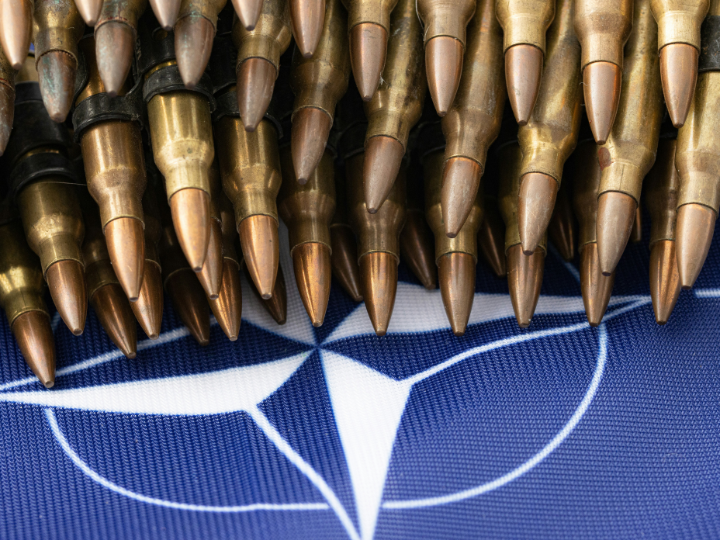
Seventy-five years of transatlantic security cooperation are being discarded by a US President whose controversial and indeed questionable business dealings have demonstrated his contempt for contracts and solemn promises. Trump’s refusal to acknowledge collective security as set out in the founding Washington Treaty’s Article 5 signals the evisceration of NATO.
It is hard to foretell the sort of security structure that might parallel or even succeed a hollowed out NATO that lacks US support. But European peacekeeping in Ukraine, if chiefly a no-fly zone patrolled by French and British combat aircraft, looks increasingly likely. Moscow warns European intervention would be “unacceptable”, yet Putin would need to think long and hard before triggering further conflict.
The transatlantic relationship is the greatest casualty of Trump’s cavalier treatment of the alliance. Over the years this has created a web of trade and investment partnerships worth trillions, and although these won’t evaporate overnight the blow to mutual trust will take a heavy toll.
‘The West’ will no longer be the cornerstone of the global economy.
A transatlantic rupture wouldn’t just be devastating on both sides of the ocean but around the world. Turmoil in financial markets and possibly a 1930s-style economic depression would risk political instabilities of the sort that provoke armed conflict.
Donald Trump’s reversal of America’s post-World War II foreign policy to favour Vladimir Putin defies rational explanation, raising speculation about possibly compromising episodes in his past career. Equally plausible is the notion that Trump and his MAGA activists see the EU and its members as ideological adversaries who must be defied.
The more positive aspect is that Europeans are at last to invest in their own security and defence. This began in earnest with Russia’s invasion of Ukraine, and is being greatly intensified by the Trump Administration’s ‘rogue’ attitude to NATO. Arguments abound over Europe’s financial commitments to defence and to supporting Ukraine, but the real problem is the lack of intra-European cooperation. That’s why talk of a “European army” is so far-fetched.
Europe isn’t as weak as many believe. A recent Pentagon report noted that its ‘below-the-line’ spending per capita on all aspects of security and defence, including peacekeeping and the cost of sanctions, matches that of the US. Europe’s challenge, as well as pouring more cash into the AI-related technologies revolutionising weaponry, is to turn its long-discussed ‘defence identity’ into a reality.
The newly-created Commissioner for Defence – former Lithuanian prime minister Andrius Kubilius – is soon to outline a strategy in a White Paper, and it is expected that it will focus on closer cooperation between Europe’s national defence giants. As Mario Draghi pointed out in his competitiveness report last year, almost two-thirds of Europe’s military equipment is US-made.
But some analysts warn against favouring big companies like Germany’s Rheinmetall, Italy’s Leonardo, Airbus Defence and BAe in the UK. Although they may be lining up to take the lion’s share of new funding, this should arguably be earmarked for innovators like Ukraine’s ‘amateur’ drone-makers and the digital ‘unicorns’ that thrive in Silicon Valley but not yet in Europe.
*Founder of Friends of Europe
**first published in FriendsofEurope
 By: N. Peter Kramer