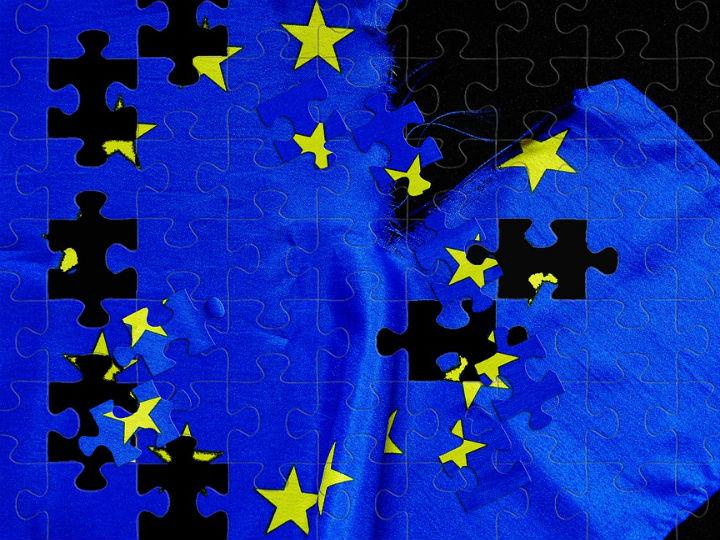
by Uwe Bott
In a world where one day a country seeks integration and the next day an isolationist comes along and throws even the notion of global or cross-border cooperation into the trash bin, one of the most important aspects of the rule of law is deeply eroded: The predictability of outcome (of relations, compliance etc.).
International accords that are agreed to are only as solid and as stable and coherent as the leadership of nations signing those accords is. And that basis for constructive relationships among nations is eroding — and, therefore, predictability and, as a result, stability.
From Global Order to “Strategic” Disorder
The National Security Strategy (NSS) which the Trump Administration released on December 4, is the latest proof that all policymaking by the United States is now channeled through the very narrow lens of Donald Trump and his closest advisors. In more than one way, the 29-page paper throws out the global order, so carefully crafted by the United States and its European allies since 1945.
It replaces this order with chaotic disorder by more or less abandoning the trans-Atlantic security alliance, which kept the world safe for 80 years and the established democratic norms shared by the allies. This global, rule-based, democratically principled order had also largely served as the gold standard for the definition of freedom and democracy snd thereby governed the relationships of the United States and its democratic European allies, once referred to as the “free world’, with countries run by despots.
This disorderly “strategy” then allows Trump to favor a cozy relationship with Putin-run Russia, a regime which invaded another sovereign country, is accused of committing serial war crimes and has unapologetically assassinated Russian dissidents on the soil of democratic European allies of the United States.
Power plays and economic leverage
At the same time, China is trying to use its position wherever it has achieved dominance, such as in rare earths, to impose its will on other nations. There are workarounds and long-term solutions, but for now it is what it is.
The overpowering role of the U.S. economy, if run by a nationalist, is similarly harmful to much of the world. Maybe there are workarounds, but they too are longer term and meanwhile it is what it is.
Broken supply chains, broken trust
The breakdown of supply chains during the pandemic and further disruptions after the Russian attack on Ukraine, too, is a problem. Developing alternative supply chains certainly is a “solution.” But again, it takes time.
Meanwhile, countries that are still tied to the liberal world order, i.e., to a rule-based international society, have become increasingly unstable themselves.
Democracies under pressure
They are not just facing international disorder, but domestic challenges from outspoken nationalists. In response, these nations are increasingly at risk to become rule-breakers themselves.
Consider the post-fascist and post-military junta transition of Spain and Portugal. It took place in the good old days of the late 1970s. Back then, international rule-of-law was essentially beyond question, even if not always complied with.
Integration tested in Europe
Since these nations wanted to be part of the EU, there was no question that they had to adopt the organization’s governing principles.
This has been less true with countries like Poland, and especially Hungary and Slovakia. While they have benefitted greatly from their integration in the EU on the economic and regulatory front, various of their governments have deliberately failed to comply with the EU’s democratic standards.
This has held back the EU’s political integration and, by extension, also the prospects for the much-needed further levels of economic integration for the European economy to remain a power factor on the international front.
When rules give way to rulers
Thus, even inside the EU the certainty that integration strengthens a rules-based world order is shaken. To be sure, it was never a perfect world — still…
All of that weakens integration to act as an antidote to U.S. isolationism, supply chains problems or Chinese rare earth dominance.
The age of the ruler-based world?
Sadly, we no longer live in a rule-based world. Around the globe we have moved into a phase of ruler-based societies.
The very real risk is that this, in turn, will foster large-scale disintegration, “post-democratic” rule and, yes, conflict at home and abroad no matter where we live.
Let us hope that we can turn things around.
*Uwe Bott is Chief Economist of The Global Ideas Center and Senior Editor at The Globalist [New York/United States]
**Published first on The Globalist
 By: N. Peter Kramer