Friedrich Merz was on course for a “disastrous” defeat in two key elections on Sunday night, but vowed to fight on as Germany’s chancellor.
An exit poll for the eastern state of Mecklenburg-Vorpommern showed his Christian Democrats (CDU) trailing the hard-Right Alternative for Germany (AfD).
For the election in Berlin, the CDU was projected to lose to the hard-Left Die Linke party, which polled at 24.5 per cent of the vote.
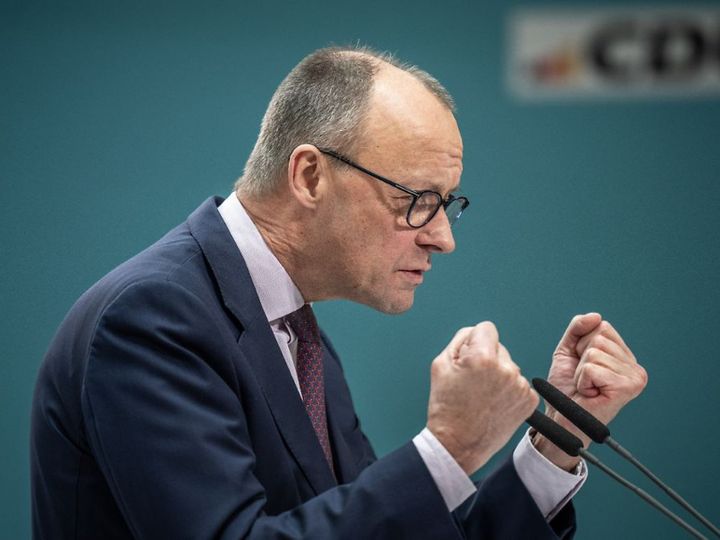
In an address to the nation minutes after the exit polls were released, Mr Merz admitted the results “cannot be sugar-coated and ... are a disaster” for his centre-Right party.
In Mecklenburg-Vorpommern, the AfD surged in popularity, with the polls indicating it was on course to winning 37 per cent of the vote.
The CDU fell below the 5 per cent threshold, according to preliminary results, which would mean that for the first time in German history the party has failed to enter the state parliament.
It is set to be the party’s worst performance by far in an election. The final results for both elections are expected early on Monday.
The results are being closely watched in Europe as the Kremlin-friendly AfD has campaigned to end sanctions on Russia and halt weapons deliveries to Ukraine.
There was grim silence at the CDU’s election party in Schwerin, the state capital of Mecklenburg-Vorpommern, as the exit polls were revealed.
“We cannot sugar-coat the result in Mecklenburg-Vorpommern. It is a disaster,” Mr Merz said in a combative speech in which he insisted he would stay on as chancellor.
Society ‘polarised’
He blamed the polarisation of German society and a “harshening of the political debate” for his failure to pass key reforms on the economy and to stop the rise of the AfD.
But he said he would struggle on as leader of the country and the CDU, vowing: “I accept this responsibility because I want to move our country forward.”
While the exit polls showed the AfD hugely increased its vote share in Mecklenburg-Vorpommern, from 16 to 37 per cent, it fell short of a majority and will struggle to form a government.
“We are the strongest force and have reached the mainstream of the population,” said Alice Weidel, the AfD’s co-leader, adding that it had “displaced the CDU as the people’s party”.
Under Germany’s Brandmauer (or firewall) policy, traditional parties refuse to co-operate with the AfD as it is classified as a Right-wing extremist group by the country’s domestic spy agency.
The centre-Left Social Democrats, which came a close second in the Mecklenburg-Vorpommern poll with 35.5 per cent of the vote, could potentially govern the state via a coalition with the Greens, CDU and Die Linke.
In Berlin, the clear winner was Die Linke, which exit polls showed was in the lead on 24.5 per cent of the vote, ahead of the CDU by four percentage points.
Elif Eralp, the Berlin faction leader, will become the capital’s first mayor of Turkish origin if she is able to build a coalition to lead the city state.
Mr Merz is facing pressure to resign over his failure to reform Germany’s ailing economy and hold back the rise of AfD.
With an approval rating of just 10 per cent, he is deeply unpopular with voters and his own party members, who have described him as out of touch, arrogant and tone deaf to public sentiment.
Earlier this month, Mr Merz refused to step down despite a catastrophic election result in Saxony-Anhalt, in which the AfD won an unprecedented 43.8 per cent of the vote.
Even though his CDU party the AfD trailed at 17 per cent, one of its worst performances in memory, Mr Merz insisted in a speech the next day that he would fight on as chancellor. He continues to resist internal party pressure to step down and allow a more popular successor to take the reins at the CDU.
Among the names circulating is Hendrik Wüst, the state leader of North Rhine-Westphalia, who has been compared to Andy Burnham, and Markus Söder, the head of the CDU’s sister party in Bavaria.
Last week, Mr Merz was forced to cancel plans to speak at the UN General Assembly in New York as his party said “his presence is required in Berlin”.
The announcement fuelled speculation he could face a leadership challenge as soon as Monday.
The chancellor, who has been in power for only 16 months, vowed to counter the rise of the AfD and breathe life back into the German economy when he came to power in May 2025.
But since then, the AfD has continued to surge in the polls and went extremely close to winning an absolute majority in the Saxony-Anhalt state election.
Had the AfD secured a majority, it would have become the first hard-Right party to control a German state since 1945.
Mr Merz had also promised to tackle rising unemployment, the decline of the manufacturing industry and the soaring cost of pensions, but is yet to deliver significant results.
Although he has won plaudits abroad for his plan to build “the strongest conventional army in Europe”, the chancellor’s decision to fund the rearmament drive with public debt has alienated voters at home.
*Published first on The Telegraph
 By: N. Peter Kramer