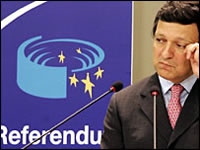
Voters in The Netherlands have firmly rejected the EU constitution, just three days after France's "Non". So, what happens next for Europe?
Is the constitution now dead?
The constitution cannot come into effect unless it is ratified by all 25 EU members - as is made clear in Article IV-447. This states that the treaty will come into effect when "all the instruments of ratification have been deposited."
Although the result of the Dutch vote is technically non-binding, the government cannot ignore it. So the Dutch and French votes mean that, as things stand, there will be no constitution.
What are the next steps?
An EU summit, known as the European Council, is being held on 16-17 June in Brussels. This will have to examine whether it is worth carrying on with the ratification process in other member states or whether to declare the treaty dead.
The Commission President Jose Manuel Barroso wants all governments to carry on with their ratification procedures to see where the final balance of opinion lies. The treaty itself implies that all member states will try at least to ratify it, but does not specifically state this.
Is there a plan B?
Not really. However, there is a procedure to discuss deadlock. The draft constitution says (in Article IV-443-4) that if, after two years from the treaty being signed (which was on 29 October 2004), 20 member states have ratified it and others "have encountered difficulties", the "matter will be referred to the European Council".
It does not say what the European Council should do. It is possible that the Council might seek to revive the treaty in some way or try to agree on some limited measures but that is for a decision at the time.
Can the EU manage without a constitution?
Yes. It will continue to function on the basis of the existing treaties. It is the future direction of the EU which is now called into question.
Could the constitution be renegotiated?
It is possible that some governments will propose a "treaty lite", but that would take several years to negotiate. Others might suggest some lesser reforms which would not require a treaty change. Some might even try to forge ahead with integration on their own to form an inner core.
But nothing is likely to happen in a hurry.
Who has ratified the treaty already?
Austria, Hungary, Italy, Germany, Greece, Lithuania, Slovakia, Slovenia and Spain.
Who else is having a referendum?
Luxembourg: 10 July; Denmark: 27 September; Ireland: Late 2005; Portugal: Late 2005; UK: April to June 2006?; Czech Republic: June 2006?; Poland: No date set.
Will other countries go ahead with their votes?
It is up to them. The British Foreign Secretary Jack Straw is to make a statement to Parliament on Monday. He is expected to put a referendum on hold at least. On the other hand, Ireland says it will go ahead. Poland is debating the issue. Not all countries are holding referendums.
Why did the French and Dutch vote "No"?
The French did so partly as a protest against the government, especially over the economy.
On the left, many voters believed that the constitution would create an ultra-free market economy within the EU.
On the right, voters were concerned that France is ceding too much sovereignty to the EU.
The Dutch were also concerned about the place of the Netherlands in an enlarged EU, fearing the effects on a smaller member state with liberal traditions
What is at stake for the EU?
The EU has still to decide what it wants to be - a tight organisation in which member states surrender or share significant sovereignty or a looser grouping of nation-states. The constitution laid out a compromise whereby it would become more integrated in many areas while leaving veto rights with member states in such key matters as foreign policy, taxation and defence.
The EU also has to face the problem of the mismatch between the views of the people and the views of the politicians.
 By: N. Peter Kramer