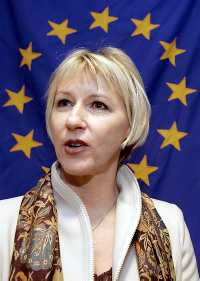
Listening, communicating and connecting by going local, are the main principles of the European Commission
According to Margot Wallstrom, Communication Commissioner, connecting with citizens of the European Union (EU) is one of the strategic objectives of the Commission for this term of office. The Commission' s seminar on communication, on 23 April, highlighted the vital importance of a renewed commitment to communication with European citizens. It also acknowledged that this is a task that goes beyond the Commission' s remit. Its success depends fundamentally on a partnership with all other key players in European politics.
Learning lessons from the recent past experiences, said Mrs. M. Wallstrom, the Commission endorsed a new communication approach underpinned by three principles: a) Listening: Not just to inform EU citizens, but also to listen to them and take their views into account; b) Communicating how EU policies affect citizens' everyday life; c) Connecting by going local, that is by adapting messages to target audiences in each Member State and conveying them through the channels those audiences prefer in the language they understand.
This approach will be achieved in two phases: i) An internal action plan which will address concrete measures to be taken within the Commission, with a view to first "putting our house in order", ii) A White Paper to engage all stakeholders, setting out the policy vision and the initiatives to be undertaken in the medium and long-term, in cooperation with the other institutions and actors, and particularly the Member States governments.
This action plan proposes a working method whereby communication tools and services, as well as human and financial resources devoted to communication, are efficiently used so that the Commission can improve its performance in communicating Europe. This involves:
-Focusing communication efforts and resources on priorities, in order to ensure impact.
-Coordinating communication activities across the Commission to maximize efforts and use our communication tools better. Improving the Commission' s ability to communicate in the Member States on EU issues as part of the national debates via the Representations in Member States.
-Using better those communication tools people prefer and in the language they understand, particularly internet and audiovisual services.
-Becoming more professional in communication through specific training and recruitment of communication specialists.
-Using practices such as a layman' s summary in main Commission proposals describing the tangible benefits of EU policies for the citizens.
The action plan involves the whole Commission, from Commissioners to staff. Actions vary in nature and scope. Some can be implemented already in 2005; others will take longer, as they depend on significant changes in the Commission' s culture and working methods. The success of many of them is highly dependent on sufficient financial and human resources being made available for their implementation.
The Commission is therefore asked i) to approve the action plan to improve communicating Europe by the Commission, ii) to take note of the indicative resources requirements set out in the financial statement in view of the allocation of resources of 2006 and of the APS 2007, on the basis of an overall assessment of Commission resources for communication, in order to implement this action plan locally through the reinforcement of Representations.
It was time for the Commission to realize that, without communication, the word "citizenship" is empty. Commissioner Wallstrom, though, still faces the tough task of convincing her fellow Commissioners of her ideas, with all of them having their own thoughts on how to spend the EU budget.
 By: N. Peter Kramer