The OECD has warned that the eurozone could be damaged more than the US by the soaring oil prices, urging the European Central Bank to run a 'very expansive' monetary policy in order to avert an economic downturn.
The Paris-based body, representing 30 of the world's richest countries, argues the full consequences of the US natural disaster for the world's economy have not been estimated yet.
But the combination of the direct damage in the US and rising oil prices is likely to cause greater problems for the eurozone's slowly recovering economy, according to the OECD's chief economist, Jean-Philippe Cotis.
"In the US, if we take an optimistic scenario, the hurricane could lead to a slowdown, but in relation to an economic situation which was on a strong path, whereas in the eurozone, the growth was far more fragile, more modest", he was quoted as saying by The Times.
The organisation has not changed its forecast for US growth for this year - standing at 3.6 percent - and raised its projection for the eurozone from 1.2 percent to 1.3 percent.
But its chief economist warned that "elevated [oil] prices may be here to stay for some time", adding that the shock caused by their jump has not yet "reached its conclusion".
FT Deutschland quotes Mr. Cotis as saying that the European Central Bank should run a "very expansive" monetary policy in order to avert a possible economic downturn caused by the high oil prices.
Mr. Cotis' appeal goes againt the ECB's restrictive monetary philosophy, which is based on the idea that economic growth should be stimulated through structural reforms by governments rather than by the ECB pumping cash into the economy.
The ECB considers its main objective is to avoid inflation.
But France, Germany and Italy have repeatedly called upon the ECB to make its policies more expansive and focus more on growth and less on inflation.
Schroder wants to fight speculative oil trade
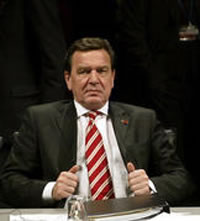
Meanwhile, German chancellor Gerhard Schroder has also stepped into the debate about the current situation relating to the oil markets.
Speaking out less than two weeks before the 18 September parliamentary elections, Mr Schroder suggested the impact of speculative oil trading should be reduced, as it stands behind the rise in oil prices, the FT reports.
He called for "more transparency in oil pricing", pointing out that he had proposed some measures at the G8 world's richest states' summit last July.
However, he said he had encountered opposition to his initiative at the time, mainly from his UK and US counterparts.
 By: N. Peter Kramer