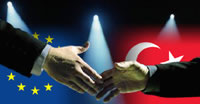
The European Union and Turkey have finally agreed on a negotiating framework that will allow formal talks on Turkish membership of the EU to begin. Within Turkey and outside it, there are questions about the predominantly Muslim country's readiness for Europe
When the countries of the European Union agreed last December to grant Turkey its fondest dream and begin formal talks on admitting the big, predominantly Muslim nation as a member, it was no doubt envisaged, or at least hoped, that the date pencilled in the diary for the start of the process would be a time of ceremony and celebrations, not bickering and brinkmanship. But the EU wouldn't be the EU without those last-minute panics, replete with desperate horse-trading and just-good-enough fudges, and in this respect Monday October 3rd did not disappoint. For much of the day, it looked like the love affair was in real danger of ending in acrimony. But thanks to some frenzied diplomatic activity, it ended instead in a firm-though hardly warm-embrace.
The main sticking point had been the insistence by Austria's government, ostensibly isolated but perhaps tacitly backed by others in the EU, that Turkey be given an explicit alternative to joining the EU: a "privileged partnership" that falls short of full membership. As a result, by the middle of Monday afternoon, European diplomats still had not agreed a common negotiating framework for the accession talks, which had been scheduled to begin officially at 5pm with a ceremony in Luxembourg attended by EU bigwigs and Turkey's foreign minister, Abdullah Gul. It was finally conceded that, with the deadlock still not broken, there was no way the event could be held on time. "We are on the edge of a precipice," said Jack Straw, Britain's foreign minister and chairman of the emergency talks.
A couple of hours later, the EU stepped back from the edge. A common negotiating framework was finally agreed, after Austria had been persuaded to step back in line. There followed further confusion, with the spokesman for the Turkish prime minister, Recep Tayyip Erdogan, having to dismiss reports that his country had accepted the draft. Finally, several hours after the ceremony had been due to take place, the Turks confirmed that they could indeed live with the document and that Mr Gul would be heading off to Luxembourg.
It appears that Austria's co-operation was bought by clearing the way for Croatia to open EU membership negotiations of its own. Croatia is an Austrian ally, and the government in Vienna had linked the Turkish issue with the Croats' stalled bid to start accession talks. The EU put its talks with Croatia on hold in March because, it said, the country's government was not co-operating fully with the United Nations war-crimes tribunal for the former Yugoslavia. But in a statement on Monday whose timing was almost certainly not coincidental, Carla del Ponte, the UN war-crimes prosecutor for the Balkans, announced that the Croats were, after all, doing everything they could to locate and arrest a key suspect, General Ante Gotovina.
Though Austria has been persuaded to drop its objection to Turkish membership of the EU, it takes over the Union's presidency in January (for six months) and may use its position to try to revive its idea of a partnership, instead of full membership. It is a view that plenty of others find appealing. Nicolas Sarkozy, a popular Gaullist who is well placed to win the French presidency in 2007, opposes Turkish membership. So does Angela Merkel, who is favourite to take Germany's chancellorship following its recent elections, which ended in a hung parliament. Overall, just 35% of EU citizens support Turkish membership, according to a recent poll by Eurobarometer. Europeans are queasy about the idea of taking in a populous Muslim member, and of hordes of Turkish job-seekers overwhelming the EU's current members.
The suspicion is mutual
But Turkey has doubts about the EU too. Indeed, it raised last-minute objections of its own on Monday, insisting on clarification of a clause in the draft negotiating framework that says Ankara may not block the accession of EU states to international organisations and treaties. Turkish nationalists and generals expressed concern that this might prevent Turkey, a member of NATO, blocking Cyprus, which remains divided into ethic Greek and ethnic Turkish republics, from joining the military alliance. Turkish fears were only eased after America's secretary of state, Condoleezza Rice, telephoned Mr Erdogan to assure him that the proposed negotiating framework had no relevance to NATO.
Indeed, now that the European club of nations has finally begun formal talks with Turkey, the focus may shift to the resistance among the Turks themselves to the legal, economic and cultural changes that the EU is demanding.
For Turks who want a European future, there was a dollop of hope last month, when brave historians managed to hold a conference in Istanbul to discuss the fate of the Ottoman Armenians. It was the first time Turkish pundits were permitted to challenge publicly the official line, holding that the mass deportation of Armenians in 1915 did not amount to a conspiracy to kill them. As participants read out letters between the "Young Turks" then ruling the empire, a rapt audience was left with no doubt that hundreds of thousands of Armenians were deliberately slain.
Planned originally for May, the Armenian forum was called off then at the behest of Cemil Cicek, the justice minister. It was nearly scuppered anew a fortnight ago, when an Istanbul court used a technicality to order its cancellation. This time Mr Cicek offered a way out-changing the venue. And Mr Erdogan condemned the court ruling: the first time an elected leader had so publicly rebuked Turkey's courts. It was also the first time that Mr Erdogan had so clearly given a lead to public opinion instead of pandering to populism. Cynics, recalling Mr Erdogan's earlier moves to appease conservatives by criminalising adultery, saw this outburst of liberalism as a last-ditch effort to clinch the October 3rd date. Be that as it may, people close to the prime minister insist he has pinned his political fortunes on further reforms, with or without the EU. "He can't compete on nationalism with the ultra-nationalists, so it's in his interest to keep on reforming," says a western diplomat.
This may explain some other recent moves by Mr Erdogan: he dared to admit in a speech that Turkey had erred in its dealings with the Kurds. These frank words enraged nationalists, including some members of his own party. In the country as a whole, nationalism has been bubbling: it has been rising since June 2004, when the outlawed Kurdistan Workers' Party (PKK) ended a five-year truce. A recent poll shows the jingoistic Nationalist Action Party, which failed to enter parliament in the 2002 elections, would gain seats today.
As well as countering this dark mood, Mr Erdogan must cope with foes in the army who fear that rapprochement with Europe will reduce their power-and who see in Turkey's internal conflicts a chance to restore that influence. But Mr Erdogan has rebuffed army demands to re-introduce a draconian anti-terror law. Solving the Kurdish problem requires more democracy, not repression, he insists.
Another challenge, in his dealings both with sceptical Europeans and his own voters, is to honour his claim to be giving Turkey its first clean government. Charges of irregularity in the sale of shares in the state refinery, Tupras-and also in a tender for the operation of Istanbul's Galata port-have weakened that claim. Unless he deals with sleaze, Mr Erdogan may lose the trust of his own citizens and his European partners. That would be a pity, when the prime minister has risked so much for Turkey's European future.
 By: N. Peter Kramer