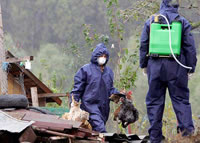
European countries are taking emergency measures to contain the spread of a deadly strain of bird flu-which has already led to the deaths of millions of birds and 60 people in Asia-after confirmation of its arrival in Romania and Turkey, and possibly Greece. The disease is a serious threat to the world's sizeable poultry industry but its spread round the globe also increases the chances of it mutating into a form that causes a human pandemic
There were fears that the deadly H5N1 strain of bird flu, which has already led to the deaths of millions of fowl and more than 60 people in Asia since an outbreak began in South Korea in 2003, may have reached the European Union on Monday October 17th, when Greece said tests had suggested its presence at a poultry farm. However, by Wednesday, doubts had been raised about the reliability of the test results. In recent days the disease has already been confirmed in Romania's Danube delta, where the authorities ordered a cull of poultry in the affected areas, and in Turkey. Migratory birds seem the most likely explanation for its spread.
Despite Romania's assurances that the cull had been completed in the two affected towns and that no further cases of the disease had emerged, neighbouring Bulgaria was setting up a national crisis headquarters and stepping up surveillance of farms and wetlands along its Danube boundary. Up river, the southern German region of Bavaria ordered the closure of its poultry markets.
The European Union has moved swiftly to ban poultry imports from Turkey and Romania. Last Friday the EU's member states agreed measures to cut the risk of the outbreak's spread, including improved surveillance along migratory birds' flyways. Other sensible measures which may be considered if the disease does continue spreading include keeping all poultry indoors-some German states have already ordered this.
On Tuesday, the EU's foreign ministers and other officials met to review plans for coping with the outbreak. After the meeting, the Union's commissioner for health, Markos Kyprianou, insisted that the arrival of the deadly bird flu in Europe did not affect the chances of it developing into a human influenza pandemic.
In America, the Bush administration, following criticism of its response to Hurricane Katrina, is straining to demonstrate it is alert to the risks the disease poses, and is expected shortly to publish an emergency plan for dealing with a bird-flu outbreak, which the government has been working on for some time. Canada will host a summit of health ministers and officials later this month, to discuss international co-ordination of efforts to curb the disease's spread.
One priority that ought to be discussed at this summit is how to help poorer countries, where people are more likely to live in close contact with animals and birds, to improve their veterinary services and disease surveillance. Public-health officials have also suggested a fund to compensate farmers who have to cull poultry. In cases where such countries cannot contemplate the destruction of such an important food source, an alternative to culling might be to vaccinate flocks in affected areas-in which case, richer countries could help out by supplying vaccines.
The threat to humans
Poultry-keeping is big business, so a pandemic among birds would be bad enough news. But it could be worse still: the more widespread the occurrence of the disease in birds, the more likely it is that the virus will either mutate into a form easily transmissible between people, or "recombine" (swap genes) with an existing strain of human influenza, resulting in a human pandemic that kills millions. That said, Mr Kyprianou has a point: there is a much lower risk of such a human pandemic getting started in Europe, whose health systems and disease surveillance are strong, than in poorer countries, where the spread of the disease from birds to people is much less likely to go unchecked.
So far at least, this strain of bird flu has proved rather hard for people to catch. But this could easily change. Scientists believe that H5N1 is a very good candidate for becoming a human pandemic strain. It mutates rapidly, has a propensity to acquire genes from viruses infecting other animal species, and has already shown itself capable of causing severe illness or death in people.
Human flu pandemics are expected three to four times every century, though it is still hard to predict when or where the next one will begin. The worst in living memory, in 1918, killed perhaps 50m people worldwide. Though there are no signs yet of such a grave risk to human life, the European Commission is urging the 25 EU member countries to stock up on anti-viral drugs and the World Health Organisation is urging all countries to produce contingency plans. On Tuesday, Roche, a Swiss drugs firm, said it would consider granting other firms licences to produce its anti-viral treatment, Tamiflu, to ensure that supplies were sufficient.
Even if an outbreak of a new human flu strain were quickly contained, it could still have drastic economic consequences. The outbreak of severe acute respiratory syndrome, or SARS, in Asia in 2003 only infected around 8,000 people and killed about a tenth of these. According to the most pessimistic estimates, it caused almost $60 billion of lost output, with tourism-related businesses being especially hard hit.
A large-scale outbreak of human flu would put health services under enormous strain. To slow its spread, such measures as the closure of schools and the prohibition of large social gatherings might need to be contemplated. However, since people with the flu virus can be highly infectious despite showing no symptoms, it would be almost impossible to create an effective quarantine regime.
In the short term, anti-viral drugs will need to be stockpiled in those countries that can afford them, and decisions will need to be taken about who (eg, health-care workers) should have priority in receiving them. A vaccine against any new strain of human flu might take many months to develop. On Monday, Thomas Lonngren, the head of the European Medicines Agency, said such a human vaccine might not be ready before next year's winter flu season.
In the longer term, maybe five to ten years, research into new treatment options, diagnostics and epidemiology could transform the situation: it is not unthinkable that an all-purpose "magic bullet" flu vaccine might be created, which prevents all strains, old and new. Until then, all countries need to prepare for the worst.
 By: N. Peter Kramer