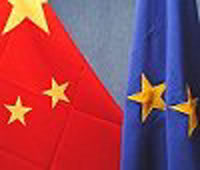
China will use upcoming visits to Europe by its top leaders to push an ambitious diplomatic agenda with the European Union, with the bloc's 16-year-old arms embargo and trade issues likely to dominate talks.
Chinese President Hu Jintao kicks off a European tour with stops in Britain, Germany and Spain, while Premier Wen Jiabao will visit four EU countries in early December, including France.
"This is evidence of China's increasing influence on the world stage," says Gilles Guiheux, director of the French Center for the Study of Contemporary China in Hong Kong.
Just a few days before Hu's arrival in Britain, which currently holds the EU's six-month rotating presidency, China revived one of the thorniest issues in their relations -- the bloc's arms embargo against Beijing.
"All the leaders of the EU that I have come in contact with believe that (the embargo) is a legacy of the Cold War, is poorly founded and is useless and only harmful," Chinese Foreign Minister Li Zhaoxing told journalists Friday.
"This should have been thrown into the trash heap of history a long time ago," Li said, highlighting the fact that the embargo was having a negative impact on trade and should be lifted.
The ban -- implemented following the brutal crushing of the 1989 Tiananmen democracy protests -- as well as the row over Chinese textile exports are sure to figure high on the agenda for Hu's talks with EU leaders.
Analysts say the EU is not yet ready to budge on the arms embargo. France and Germany have urged the lifting of the ban, but Britain and other EU nations disagree, citing US security concerns in the Asia-Pacific region.
"The Chinese know all too well that Europe is not going to move forward on that," says Jean-Pierre Cabestan, director of research at the French National Center for Scientific Research and an expert on contemporary China.
EU leaders once pledged to remove the ban by June this year, but China's anti-secession law on Taiwan, passed in April, stymied the effort due to heightened concerns that the law could eventually lead to war in the Taiwan Straits.
Economic issues beyond the textile row are likely to dominate Hu's visits to Britain, Germany and Spain -- his first trips to those countries since taking power three years ago.
After talks with British Prime Minister Tony Blair in London, Hu was to meet with incoming German chancellor Angela Merkel in Berlin, where he was expected to sign a contract with engineering giant Siemens for 60 high-speed ICE trains.
"For China, Europe is above all a source of capital and technology," says Guiheux, adding that the EU lags far behind the United States in terms of political influence in Beijing.
As evidence of Washington's higher profile in China, US President George W. Bush is due in Beijing on November 19 after the Asia-Pacific Economic Cooperation (APEC) summit in South Korea.
"On all the major issues, the Europeans stand out because of their absence," Guiheux notes, emphasizing the stronger positions taken by Washington on a number of points, including concerns over increased Chinese military spending.
In Madrid, from November 13 to 15, Hu will meet with King Juan Carlos and Spanish Prime Minister Jose Luis Rodriguez Zapatero.
Next month, Wen will visit France, Portugal, the Czech Republic and Slovakia, a trip that was scheduled for mid-October but later pushed back due to a major Communist Party meeting and China's second manned space mission.
 By: N. Peter Kramer