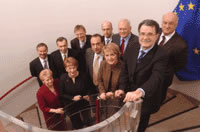
After his first set of commissioners was rebuffed by the European Parliament, Josι Manuel Barroso, the head of the next European Commission, has revealed his new line-up
STICK, twist or shuffle? It was not obvious how Josι Manuel Barroso, the head of the incoming European Commission, should play his hand in the weeks after his original suite of 24 commissioners failed to find favour with the European Parliament. Should he stick with his controversial colleagues, such as Rocco Buttiglione, the Italian Catholic named as justice commissioner, who outraged many parliamentarians with his conservative views of gays and women? Should he hold on to Laszlo Kovacs, the Hungarian, who displayed neither love nor understanding of the energy portfolio he was given? Should he perhaps ask the Hungarians and the Italians to discard their nominees and draw fresh cards from the deck? Or maybe he could get away with shuffling his hand a little, moving Mr Buttiglione and Mr Kovacs to new posts, where their creed or credibility would not be questioned.
In the end, he has been forced to twist and shuffle. Mr Buttiglione resigned on October 30th, after his sponsor, Silvio Berlusconi, the Italian prime minister, decided it was not worth fighting to keep him. In his place, Mr Berlusconi has offered his foreign minister, Franco Frattini, who will carry the justice portfolio and serve as one of Mr Barroso's five vice-presidents. Schooled in the worldly disciplines of law and politics, Mr Frattini will present a striking contrast to the man he replaces, whose excursions into political philosophy and Catholic orthodoxy brought him so much grief. Mr Frattini, one supposes, is less likely to cite Kant in his confirmation hearings and more likely to recite the cant ("I promise to uphold the European ideal", etc) that his parliamentary inquisitors want to hear.
Mr Buttiglione is not the only nominee who failed to make the cut. Ingrida Udre, the Latvian commissioner given responsibility for taxation, was also asked to withdraw after expressing a "healthy euroscepticism" parliamentarians found difficult to digest. The Latvians hope their new nominee, Andris Piebalgs, will be more acceptable. He is an old Brussels hand who led the country's negotiations to join the European Union and heads the cabinet of Latvia's current commissioner, Sandra Kalniete.
Mr Piebalgs has one other advantage. He knows something about science, which makes him a more plausible candidate for the energy portfolio Mr Kovacs struggled to understand. The Hungarian's shaky grasp of energy and his tainted past as a Soviet-era communist made him politically vulnerable. If the socialists in the European Parliament could claim the scalp of Mr Buttiglione, many thought the conservatives would claim Mr Kovacs. In the event, he was moved, not sacrificed, and will assume the taxation post Ms Udre is vacating.
Three of the original commission's most controversial members have now been moved or ousted, but one has sat pat. Neelie Kroes, the Dutch nominee, was deemed by some to be too well-connected to the business world she would have to police in her proposed role as competition commissioner. After serving as transport minister in the Dutch government, she sat on a dozen or so corporate boards, as well as heading up a business school. According to a recent report in the Wall Street Journal, Ms Kroes, as a minister, helped set up a lobby group for the transport industry, which she then chaired after leaving government. The group's flagship project, a proposed freight railway line from Rotterdam to Germany, was then endorsed by a study from the business school she ran. The Betuwe Line, as it is known, is now billions of euros over budget and the subject of a Dutch parliamentary inquiry.
If Mr Kovacs is encumbered by his country's communist past, and Mr Buttiglione by his country's Catholicism, Ms Kroes is in part a product of the Dutch way of doing things. Under the "polder" model, as it is called, politicians and businessmen commonly sat down together to direct the country's economic policy. The results were often enlightened. But the line between consensus and collusion can be a little blurry. Many parliamentarians worry that Ms Kroes's past will inhibit her in her role as competition tsar. To placate them, she has sold her shares, put her money in a blind trust, promised to recuse herself from cases involving companies she has served, and vowed not to return to the private sector. That was enough for Mr Barroso, who describes her as an "excellent candidate". Grumbling aside, it will probably also be enough for the European Parliament, which may vote on the new team at its next plenary session beginning on November 15th.
In all, Mr Barroso probably has a stronger set of commissioners now than he did when his first 24 names were announced in the summer. Mr Frattini is a heavyweight; Mr Piebalgs highly accomplished. If Ms Kroes still has potential conflicts of interest, at least they have been aired now, while they are still hypothetical, rather than later, in the press of an important case.
But Mr Barroso's original hand might have been stronger had he played it better. To be sure, he could not choose his own commissioners - they were picked for him by the member states. But he had some discretion about where to put them, even after taking national preferences and pride into account. Mr Buttiglione, for example, was an unpopular pick for justice commissioner because his private beliefs were deemed incompatible with his public duties to defend civil liberties. But he might have been acceptable as the commissioner for, say, transport, about which the Vatican has yet to express any strong views.
 By: N. Peter Kramer