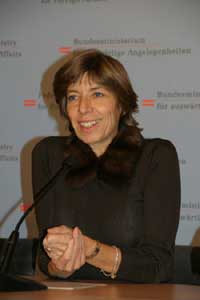
The ‘NO’ votes to the Constitutional Treaty in France and The Netherlands in 2005 plunged the EU into crisis. After the defeat, President Jacques Chirac sacked his European Affairs Minister, Claudie Haignerι, and appointed his spokesperson Catherine Colonna in the vacancy.
A year later, the political malaise in Europe is still not over. Ms. Colonna shows a strongly pessimistic view of the European Union: ,The functioning of the union, and more generally the state of the union, appears worrying to me. The European Union is suffering from a sort of illness of apathy, from general fatigue, which not promises well for its future capacity to respond to the need of the European citizens’.
She said: ‘Nobody can understand why the Europeans are unable to help one another in an organised way in fighting forest fires or, something completely different, in coordinating the evacuations of their nationals from Lebanon’. These remarks of Ms. Colonna came a day after President Chirac’s criticising Europe’s foreign policy for its failure to response to the Lebanon crisis.
Three reasons for EU in malaise
The European Affairs Minister suggested three main reasons for the current situation. The first is the enlargement of the EU with the former communist countries in central and eastern Europe. This has ‘profoundly changed the nature of the European project’, she said, ‘but the member states continue to pretend that the same European project is being pursued, only with more countries’. She continued saying, that ‘governments badly explained the 2004 Enlargement to the public and thus it is not accepted. Let’s face it: there is uncertainty about the limits of the EU and there is resistance to future enlargement, in particular Turkey, in some countries’.
Another reason according to Catherine Colonna is the fear of the EU citizens of economic and social pressure from globalisation. ‘But’, the minister said, ‘the EU should be a space of economic and social development which offers an added efficacy on top of what the member states can offer. The EU should help citizens to make the most of globalisation and -if necessary- the EU has to be a protection for them’.
The third reason according to Ms. Colonna is ‘the attraction deficit’ the EU is suffering from in the eyes of its citizens. There is a lack of delivery: ‘The Europe of results is in need of results’. She cited the services directive, which was first proposed in the beginning of 2004, as an example of how slow the legislative process can be.
The risk of the EU collapsing
‘Can the European Union carry on at this pace for long? Can Europe even take crucial decisions any more? There is practically no problem that arises that does not result in people turning towards Europe to see what it can do to resolve it’, the minister said before concluding: ‘We need a more fundamental start, if we are to avoid the risk of the European Union collapsing’.
Her warning came just a day after President Chirac told, that ‘the future of the European project is predicated on Europe’s ability to be a leading political player’.