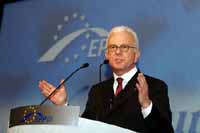
Since its first direct elections in June 1979, the tradition is that every two and a half years the European Parliament (EP) elects a new president. On 16 January 2007 it was Prof. Dr. Hans-Gert Pφttering who became the 11th elected president.
‘By historical standards two and a half years is a short time. But let us not forget, however, that one President of the European Parliament lives through five European Council Presidencies’, said Hans-Gert Pφttering in his inaugural speech for parliament. ‘This makes clear the responsibility borne by our Parliament, particularly at this time when the task of uniting Europe has come a long way, but is not yet complete and indeed, given the current failure of the constitutional process in France and the Netherlands, is still in danger. The European Parliament is aware of this responsibility, so cannot allow itself to be outdone by anybody when it comes to completing this task of unifying our continent!’
President Pφttering: ‘I share with five of my colleagues the privilege of having been a member of this parliament since its first elections in 1979. In the years since then we have lived through highs and lows in European politics. In this period the greatest success has been overcoming the division of Europe. The enlargement of the European Union with 10 new member states on 1 May 2004 plus Bulgaria and Romania on 1 January this year, together with the reunification of Germany on 3 October 1990, remain for me the miracle of this generation. But we should stop talking about the ‘old’ and the ‘new’ member states. The European Parliament represents the community of the European Union.’
A Constitution for the EU
New elected EP President Pφttering is a strong believer in the necessity of a constitution for the European Union. In his words, the EU is the largest grouping of nations in the world – 27 nations with almost 500 million citizens. Europe is a complex continent, which faces huge challenges. Therefore ‘the EU can no longer operate using the inadequate instruments of current treaty law. If our community of values is to endure, we must reform it fundamentally. The Constitutional Treaty strengthens both the European Parliament and the national parliaments; it makes for greater parliamentarianism and democracy. Communal self-administration as the basis of our European democratic order is recognised for the first time. The distribution of powers defines European competencies’.
Pφttering said, he can not understand ‘people who on the one hand criticise ‘Brussels’ – and sometimes that is just as justified as it is to criticise national politics – but at the same time reject the Constitutional Treaty, which is the very instrument we need to help eradicate and rectify the perceived deficiencies’.
He does not allow any doubt about the European Parliament standing by the Constitutional Treaty. ‘We want to help ensure that the substance of the Constitutional Treaty, including the chapter on values, becomes a legal and political reality. We need a commitment to solidarity among all 27 nations of Europe. No country, no nation of the European Union is to be left alone with its problems. But this also rules out national selfishness. The Constitutional Treaty was signed by all 27 governments. Of course, we have to respect the results of the referenda, but we do not accept that a change of government in an EU country calls into question what has been agreed. We must commit to our European legal principles: pacta sunt servanda – treaties are to be honoured’.
‘Europeans should be proud’
The new President is aware of the history of the European Union: ‘In the eighties the talk was of ‘Eurosclerosis’. But then came the single market and the single European currency. The European Parliament fought for his rights and is much more influential and self-confident now. But the real job is to serve the citizens of the European Union!’
In Pφttering opinion: ‘Europeans should be proud of what they have achieved by their labours over the centuries in terms of values, freedom, law and democracy. It has been a long haul. We know that our European roots lie in Greek philosophy, Roman law, the Judeo-Christian heritage, the Enlightenment – in other words, our shared European culture. But there have also been tragic European civil wars, and in the 20th century the totalitarian ideologies, with their disdain for humanity, and then, in 1945, the courage of the founding fathers in following the path of forgiveness and reconciliation, in building a new, better, more peaceful, shared Europe. We should still remember this today, and rediscover the things that are common to us all.’
‘The great French European Jacques Delors spoke, in the tradition of Robert Schuman, of the ‘European soul’. The great Polish European Bartoszewski once said: ‘Europe means above all else freedom of the individual and human rights – both political and economic’. They were both right. But we shall only succeed in this if the citizens of the European Union – alongside their attachment to home and their own country – - understand and are aware, as Europeans, of what binds them to one another. A sense of community and a sense of being ‘us’ are necessary conditions for our shared future. European unification is not simply a desire dictated by our minds; European unification is also an affair of the heart. Making this clear to people is perhaps the greatest challenge that European politicians must meet together.’
Dr. Pφttering also pleas for European values: ‘European values have their fundamental roots in the dignity of the individual. In the dignity of the individual we respect the other, make a commitment, and thus build a system based on responsibility and solidarity. In practical politics the dignity of the individual has to be served. I would like to encourage all European politicians to defend human dignity and human rights throughout the world. That is not an abstract plea. We Europeans are not the world’s teachers, but our humanitarian image and our values become more convincing to others if we live our own lives with credibility’
Coexistence among cultures
According to the new elected EP President ‘Europe’s future is dependent to a great extent on successful coexistence among cultures and religions within the European Union and between the European Union and our neighbours, first and foremost in the Arab and Islamic world. We must therefore do our part to ensure that dialogue among cultures and religions is the hallmark of Europe. We live in the continent of the three great cultures and religions – the Christian, the Jewish and the Islamic. And we have fellow citizens who come from one of the world’s other great cultures and who are at home in the world’s other religions. It is crucial to encouraging dialogue between cultures across the Mediterranean and beyond, to the Middle East and North Africa. We do not want the ‘clash of civilisations’, we want peace in freedom and justice among all nations and beliefs. This dialogue must be grounded in tolerance and truth. But tolerance does not mean accepting anything and everything. Tolerance means respecting the convictions of the other while maintaining one’s one, and thus coexisting peacefully.’