by
Adrien Valbray
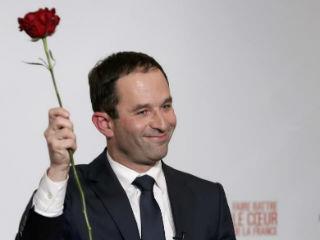
After a surprise first-round victory, Hamon took the second round of the Socialist primary by a comfortable margin. The left-wing rebel and former minister for education beat ex-Premier Manuel Valls in Sunday’s (29 January) run-off vote by 58% to 41%.
Turnout in both rounds was disappointing, but just high enough to legitimise the process.
This result has far-reaching consequences. Firstly, the monumental task of rallying support for the PS’ ailing presidential campaign now falls to Hamon.
Current polls place the former education minister’s popularity at between 7% and 9%, behind Republican François Fillon, National Front leader Marine Le Pen, centrist Emmanuel Macron and radical left stalwart Jean-Luc Mélenchon. Just reaching the second round would require a historic political comeback.
If he is to make this happen, Hamon will also have to seek party unity over his controversial election promises. The idea of a universal basic income (UBI) – the candidate’s flagship policy that would see all French citizens over 18 years old given €750 per month by the state, regardless of their financial circumstances – was sharply criticised by his rivals Manuel Valls and Arnaud Montebourg.
But in spite of this scepticism within the Socialist Party, Hamon’s commitment to a thorough rethink the social model at a time when the “Uberisation” of the labour market is making work increasingly precarious, appeared to play well with the party faithful.
Campaigning for Hamon? “This is the problem”
In these circumstances, it is hard to see supporters of Valls and outgoing president François Hollande throwing their weight behind their party’s candidate. “This is the problem,” Valls told Le Parisien, when asked if he was ready to campaign for the UBI.
This is not the only issue along which party lines are divided. Since he was ousted two and a half years ago, along with fellow left-wing rebels Montebourg and Aurélie Filippetti, Hamon has been one of the Valls government’s most vocal opponents. He even went so far as to call for a vote of no confidence in the government over last spring’s labour reforms.
In fact, many members of the PS are tempted by Macron’s campaign, which is currently surging in the polls. Several Socialist MPs close to Valls have already hinted that they may announce their official backing for the former economy minister as early as today (30 January).
Gilles Savaray, an MP and supporter of Valls, told journalists last week that he saw no problem with throwing his lot in with Macron while remaining a member of the PS. Although there is no question of an alliance between Macron and his former boss Valls.
The problem of the first secretary
Once the dust settles on the presidential election, the very future of the Socialist Party will be hanging in the balance. After the poll, and the probable heavy defeat, the PS will have 12 months in which to choose a new first secretary.
As the presidential candidate, Hamon will naturally seek this position. But he and his band of left-wing rebels only represent around 30% of their party.
The majority accumulated by Hamon and Montebourg in the first round of the primary in an illusion: it is the result of an electorate seeking to punish Valls for allegedly elbowing Hollande out of the contest behind the scenes, combined with the candidates’ popularity among voters far to the left of the PS itself.
Many Socialists fear their candidate will complete the “Corbynisation” of their party, condemning it to a long period of opposition, infighting and political irrelevance. But Valls is far from finished: the former prime minister will attempt to wrestle back the reins of the PS next year, with the 2022 presidential election already in his sights.
The left-wing primary did anything but clarify the Socialist Party’s ideological line. If anything, it served to highlight the chasm separating Valls’ brand of social-democracy, or the “realist left”, and Hamon’s authentic left-wing socialism.
After five years in power, the delicate political balance built by Hollande has well and truly collapsed.
So deep are the internal divisions that compromise has become impossible, even if it means having a real shot at the presidency.
Hollande’s ability to unite his politically diverse party as first secretary from 1997 to 2008 is what got him elected in 2012. But it was this same diversity that made his presidency so ineffective and finally led to his effective resignation: Hollande is the only serving president since the foundation of the Fifth Republic in 1958 not to stand for re-election.
*First published in www.euractiv.com
 By: N. Peter Kramer