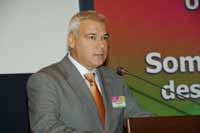
Interview with Mr. Dimitris Dimitriadis, President of the European Economic and Social Committee (EESC):
In October 2006 the EESC elected Dimitris Dimitriadis as its President for a two year term. The new President, a dynamic Greek businessman, representative of the so called ‘Employers Group’ of the committee, chose as a leitmotiv for his programme “Entrepreneurship with a human face”. In his inaugural speech Mr. Dimitriadis emphasised that “entrepreneurship is the key to facing the challenges of globalisation, but is not an objective in itself. It must have a ‘human face’ too. The ultimate purpose is to preserve our European social model, which is an example to other parts of the world, but has to be capable of facing the threats from global competition and demographic changes’.
The function of the EESC
Do not expect any hesitation when you ask Mr. Dimitris Dimitriadis to explain what the function is of ‘his’ EESC. He will tell you that in the very beginning of his mandate as President of this institution, he not only had to explain to his son and daughter but even to some European Commissioners for what reason already in 1957 under the Treaty of Rome the Committee was established: “The European Economic and Social Committee is one of the 'political' European institutions; the European Parliament, the European Commission and the Committee of the Regions are the other ones. The specific role of the EESC is to express the views and the philosophy of civil society organisations in the European Union”.
President Dimitriadis: “In our Committee you can find 344 distinguished members, all experienced representatives of the various economic and social components of organised civil society in the 27 member states of the European Union. There are representatives of employees and employers organisations, from NGO’s, consumer associations, the agricultural sector, environmentalists and so on. Their duty is to formulate the opinion of civil society and to advise the Parliament, the Commission and the Council about subjects in the legislative process of the EU. That means that as a forum for dialogue and for consultation, our committee acts as a bridge between the Union and civil society organisations across Europe”.
The EESC is not well known to everyone in the Brussels ‘arena’, and, even in the eyes of those for whom the Committee should be a familiar institution, it's usefullness is not always realised. Recently a group of European parliamentarians questioned the usefulness of the Committee. Mr. Dimitriadis makes short shrift of this: “This attempt, initiated by a small number of eurosceptic MEP's who are not at all representative for the EP, is based on a complete misunderstanding of the EESC's institutional role and competencies and therefore cannot be taken seriously. But I recognise that the existence of a consultative body for the organised civil society on european level may not be obvious for MEP's originating from Member states which do not have a similar structure on their national level".
Reform Treaty base for dialogue in European society
“We have to establish a more political vision about the future of Europe”, according to the EESC President, “The Treaty of Lisbon, the so called Reform Treaty, can be a strong base for a dialogue in European society. After France and The Netherlands voted no to the Constitution we lost too much time. In September the EESC held a conference on the theme of “Organised civil society has its say on the future of Europe”. One of the main conclusions was the need to provide structures for the genuine realisation of participatory democracy and to better involve the European citizens now”.
With its permanent connection and dialogue with national and European civil society intermediary bodies, the EESC seems able to organise debates with civil society. President Dimitriadis: “Our members are ready for it and Ms Wallstrφm, Vice-President of the European Commission and responsible for communications, told me that she would like to cooperate with us. I am very happy with that. Strengthening the relationship with the Commission was one of my aims when I started my two-year term in October 2006. Now we have to work together to explain to the European citizens what the Reform Treaty is!”
European Civil Protection Force ready before summer 2008?
The EESC and its President were strongly involved with the terrible forest fires in Greece, Spain and Romania last August. Not only did Mr, Dimitriadis express his deep grief and sorrow regarding the tragedy, but together with his colleague from the Committee of the Regions, Michel Delabarre, he also recalled the idea of former European Commissioner Michel Barnier to take action to reinforce the European civil protection mechanisms for future disasters. The two presidents found a willing ear with their colleagues presiding over the other important European institutions, Prime Minister Socrates of Portugal then holding the rotating EU Council Presidency, Prof. Dr. Pφttering of the European Parliament and Mr. Barroso of the Commission.
The answer of Mr. Dimitriadis to the question, will the civil protection force be ready before the risky period of 2008 starts, is clear: “I told Mr. Barroso that the picture of him and the Greek Prime Minister Karamanlis visiting the region immediately after the fires made the solidarity and the responsibility of the EU for its citizens visible in a far better way than by spending millions of Euros annually for brochures, magazines and conferences.”.
Work is now in progress: “We have to be prepared before it is too late. Two weeks ago I met former Commissioner Mr. Barnier, nowadays Agriculture Minister of France, together with European Commissioner for the Environment, my compatriot Dimas. It is important to organise smooth cooperation between member states. What we need is a practical mechanism to support a country with natural disasters like forest fires or flooding. We don’t need a new bureaucratic mechanism; there is already more than enough bureaucracy in the EU”.
Developing dialogue with third countries
Alongside the EU Council, the European Commission and the European Parliament, the Committee provides a unique contribution to the EU’s foreign policy activities, by championing the ‘civil society dimension’. The Committee operates directly in countries outside the EU by developing dialogue with representatives of civil society organisations. The EESC President calls the role of his institution “being a flanking partner to the EU’s official policy. As we are not politicians, and nor do we pretend to be, we can sometimes assist politicians when foreign policy is not making much progress”.
“Relations with the two most populous countries in the world, China and India, which have some of the fastest growing economies worldwide, are at the centre of our attention”, he continues. “In 2007 we had a traditional meeting of the EU-India Roundtable and the first successful EU-China Roundtable”. Relations with Brazil are developing, and closer to home with the Western Balkans, Croatia and …Turkey. “It is well known that the accession negotiations with Turkey are experiencing difficulties. I do not have to go into detail regarding the importance of this process and the key role of Turkey due to its geopolitical position. Our contribution should be to strengthen the links with Turkish civil society”.
A special place in the heart of Mr. Dimitriadis is reserved for the Euro-Mediterranean Partnership. “As a Mediterranean, I am devoting a lot of attention to this partnership during my mandate. I think it is important to create closer links with the Euromed civil societies to promote participative democracy. And allow me at this point a political statement regarding the Middle East Peace process: a lasting peace must be built on mutual understanding of the Euromed civil societies”.