by
Paul Smith*
In the wake of last month’s general election in the Netherlands, Dutch political scientist Cas Mudde focussed on this theme, pointing to the juxtaposition of Prime Minister Mark Rutte’s ‘good populism’ and the ‘bad populism’ of Geert Wilders, leader of the anti-immigration and anti-Islam Freedom Party.
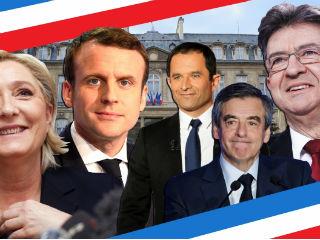
The theme also applies to the French presidential election. It seems that every man and woman among the eleven candidates running to be head of state is positioning themselves as an ‘anti-system’ candidate, each brandishing their own virtuous populism.
Only five – possibly six – stand a chance of winning more than five per cent of the vote. From Left to Right, these candidates are Jean-Luc Mélenchon, Benoît Hamon, Emmanuel Macron, François Fillon and Marine Le Pen. The sixth is Nicolas Dupont-Aignan, who has until recently has barely figured on the pollsters’ radar but who, in the face of Fillon’s decline, has advanced from around two per cent to five per cent in the polls at the time of writing.
The two with the most obviously populist messages are Le Pen, on the far right, and the ‘Left of the Left’ candidate, Mélenchon. This underlines the old truth that sometimes more binds extremes than separates them.
Both deploy the language of ‘people’ and ‘nation’ at the heart of their projects, promising to refocus the energies of the state on saving the national economy. Mélenchon’s ‘Keynesianism in one country’ and proposals for renationalisation are not so far removed from Le Pen’s ‘intelligent, patriotic protectionism’. This is not surprising when we remember that the author of her project, Florian Philippot, is a defector from the Jacobin Left.
Both Mélenchon and Le Pen see globalisation as a false dogma and the root cause of France’s economic ills. Mélenchon, a forthright critic of the European constitution that was rejected by French voters in 2005, argues that the European Union has failed to protect workers from the effects of hypercapitalism, and has become a ‘market space’ instead of a social project. If elected, he would renegotiate the treaties before holding a referendum on continued membership. For her part, Le Pen has promised an autumn 2017 referendum on France’s EU membership. Le Pen’s rhetoric relies on her role as perennial outsider: the ‘victim’ of a system that has always manoeuvred to exclude her in the same way it did her father.
Mélenchon and Le Pen would also dismantle the Fifth Republic, France’s constitutional set-up since 1958. Mélenchon would do this by means of a constituent assembly, which he hopes would lead to the creation of a parliamentary republic (not unlike the Fourth Republic, but with extended recourse to referendums and the right of electors to ‘unelect’ Members of Parliament).
Le Pen, by contrast, has promised a series of constitutional reforms that would establish national priority and a plebiscitary dictatorship. What distinguish the two from each other are their positions over immigration and culture. Mélenchon envisages a more open France with better mechanisms for integrating migrants. He is unconcerned about the ‘death’ of the French culture that Le Pen ‒ and to some extent Fillon ‒ seeks to reverse.
Of Hamon, Macron and Fillon, the least expressly populist candidate is perhaps Hamon, the Socialist candidate, who is much more focussed on the challenges regarding the mechanisation of the French workplaces and environmental issues. For him, the EU is the key to France’s future, but it needs greater democratisation through the creation of a eurozone assembly comprising members of national parliaments. But even Hamon is proposing greater use of referendums, enshrining in the constitution what amounts to a popular power of veto over legislation.
*Associate Professor in French and Francophone Studies and Head of Department at the Faculty of Arts, the University of Nottingham
**First published in europesworld.org
*Associate Professor in French and Francophone Studies and Head of Department at the Faculty of Arts, the University of Nottingham
**First published in europesworld.org
 By: N. Peter Kramer