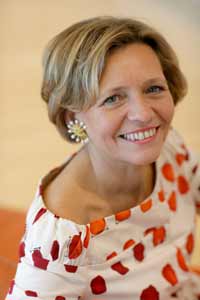
Irini Pari: Greek, Belgian and a passionate European!
‘May be we were too early. But in 2002 the European Economic and Social Committee already stated that better rules for the financial world were needed. And this opinion was not only supported by the representatives of the trade-unions and consumer organisations, but the employers group in the EESC also agreed with the point of view’, stressed Mrs. Irini Pari, Vice-President of the committee, in an interview with European Business Review.
Seven years later, on 15 January 2009, the EESC is again asking for a strategy to overcome the economic crisis through new rules designed to protect the most vulnerable members of society and support businesses in difficulty. The EESC therefore endorsed the economic recovery programme proposed by the European Commission.
Mrs. Pari: ‘The crisis we face is without any doubt serious and severe. Eighteen EU member states in recession, the increase of unemployment is dreadful, a fast rising deficit in Europe. But panic will not help! Let us try to revive the real economy: encourage investments, create jobs and help the unemployed to get back into the job market’.
Does the EEC have enough impact to make a contribution to the solution of the crisis?
Mrs. Pari: ‘I am convinced that the EESC can play an important role on the European stage. Especially now. In our committee trade unions, consumers and business people meet each other and work on finding collective answers on important questions. Don’t forget we are not politicians, not bureaucrats. The EESC provides an institutional framework for civil society.’
EESC Vice-President Pari bears out her statement by referring to a report on the impact of the EESC’s work over the period 2002-2006. It makes clear that the Committee adds substantial and wide-ranging value to the decision-making process within the European institutions. The European Commission’s quarterly follow-up reports show that most EESC opinions bring significant added value to its legislative and executive tasks. EESC recommendations are generally taken into account in, or underpin, European Parliament documents, definitive legislative acts or other high-level political declarations.
The President of the EESC, Mario Sepi, stated in his inaugural speech that your institution will focus on peoples’ feeling about the EU. Communication seems to be the keyword for that. You are in charge of the EESC communication…
Mrs. Pari: ‘Emotions are part of Europe and we have to communicate them not only here but at national and local level where people live. As you know, the European Commission has representation in the capital of all member states. We started a direct cooperation between the Commission and our committee by appointing an EESC representative in each capital, who will work close with the Commission on communication projects.
The EESC as well as the Committee of the Regions have received the observer status in the inter-institutional group of Commission, European Parliament and the European Council of Ministers, that every year decides about the topics for communication by the institutions. For 2009 economic grow in a period of crisis is number one. All partners will spend as much attention as possible to the elections for the European Parliament. A reasonable turn out of voters is our common concern.’
Irini Pari started recently her blog on the EESC website. She introduces herself: ‘I am Greek and Belgian too, but most importantly I am a passionate European’. She mentions the EESC seminar ‘Communicating Europe in Partnership – Beyond borders and cultures’. Commissioner Jan Figel from Slovakia was one of the prominent speakers and quoted on her blog, saying that ‘we will have made a step forward when people will think and feel Europe is our home’.
Mrs. Pari’s reaction is: ‘I do feel Europe is my home and it feels good living in Europe, especially in these difficult moments of crisis’.