by
John McKenna*
Between 2050 BC and the projected populations of 2050, the global centres of civilization have swung between the Middle East, Asia, Europe and North America.
The ancient world
Modern-day Iraq, Egypt and China all played host to the world’s largest cities for the first two millennia of this 4,000-year period.
With a population of just 35,000, the ancient Egyptian city of Memphis was the world’s largest for 100 years from 2050 BC.
Other Egyptian cities to feature during this early 2,000-year period included Thebes and Alexandria, which had a peak of 350,000 in 150 BC and was the largest population of any city up to 100 BC.
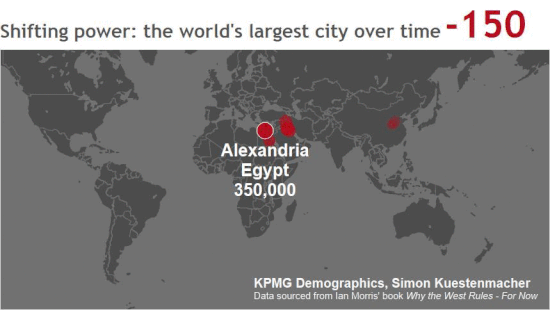
While Alexandria had the largest population, and the Chinese cities of Yinxu and Chengzhou also featured, this early period was dominated by the large populations of the ancient cities located in modern-day Iraq.
Time and again from 1950 BC until 350 BC, the biblical cities of Babylon, Nimrud, Nineveh, Ur and Uruk charted as the largest cities on the planet.
This included an uninterrupted 450-year period of domination starting with Nimrud’s population of 75,000 in 800 BC and peaking in Babylon’s population of 150,000 for 150 years between 500 BC and 350 BC.
Rome reigns
The animated map was produced as part of KPMG Australia Demographics partner Bernard Salt’s column for The Australian.
In his column, Salt identifies Rome as the standout city for the whole of the 4,000-year period.
“By the time of Jesus Christ, Rome had a million residents,” writes Salt.
“It was three times the scale of the previous biggest city, Alexandria. To place this in perspective, today’s biggest city, Tokyo (38 million), would need to be 78 million, or three times Delhi, which is the next largest, to have the same world impact as Rome did at the time of Christ.”
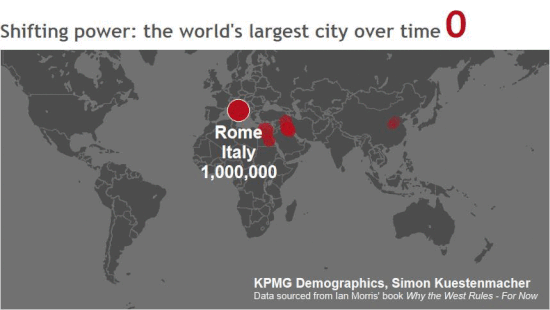
Rome stands out for both its scale and longevity. It was the world’s largest city for 550 years from 100 BC to 450 AD. This included a 250-year period at the start of the first millennium where Italy’s capital had 1 million residents.
It would be another 450 years before another city – Chang’an in China in 700 AD – would again reach 1 million inhabitants.
Industrial explosion
No city surpassed 1 million inhabitants for 1,400 years, until Beijing’s population hit 1.1 million in 1850.
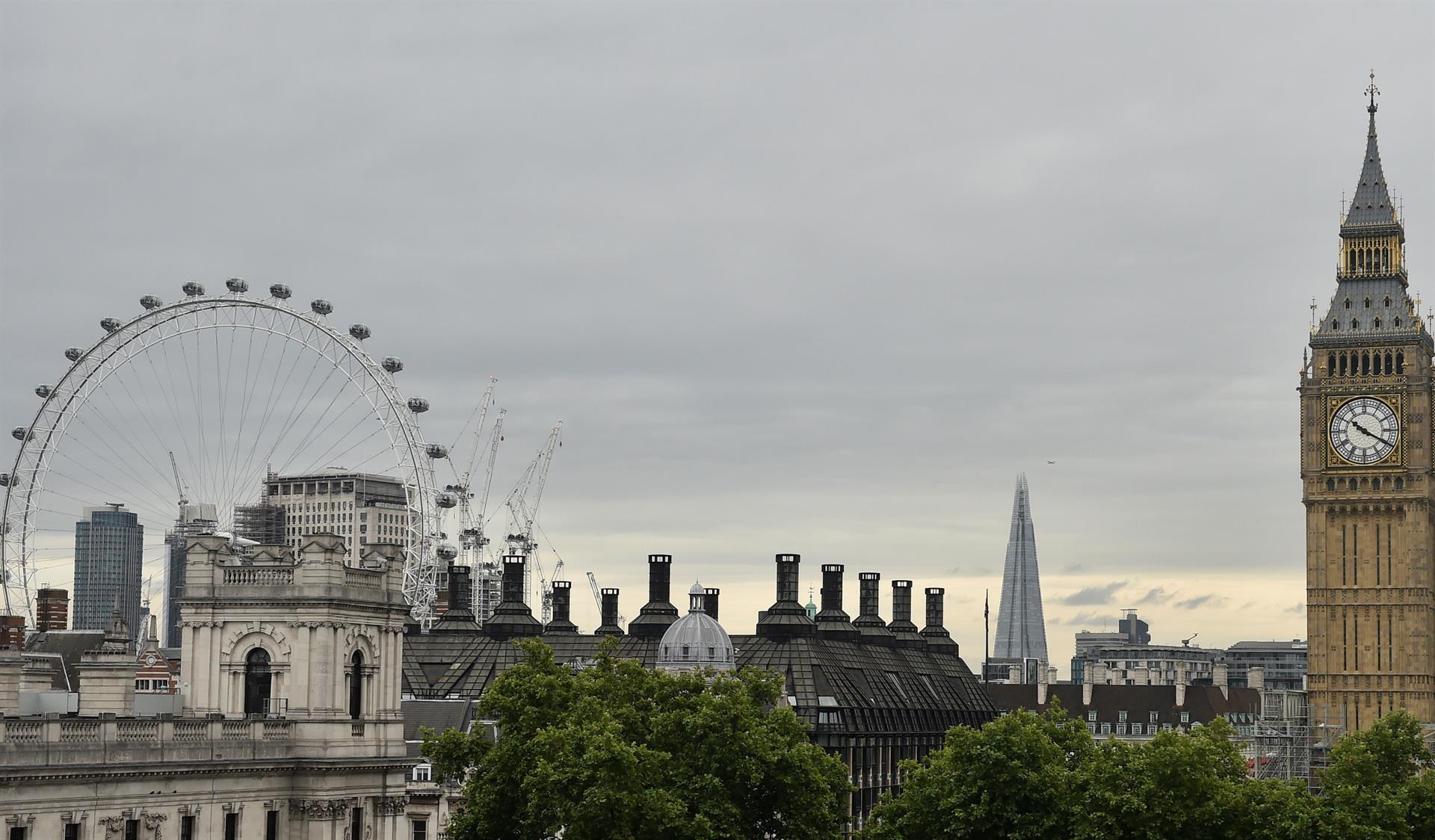
The Chinese capital was soon outdone by London, which thanks to the Industrial Revolution and expansion of the British Empire was the world’s largest city from 1850 to 1900, with a population growing from 2.3 million to 6.6 million.
Industrialization at the turn of the 20th century proved pivotal for rapid population growth across the globe.
London’s dominance was superseded first by New York with a population of 12.3 million in 1950 and Tokyo with 26.4 million residents in 2000.
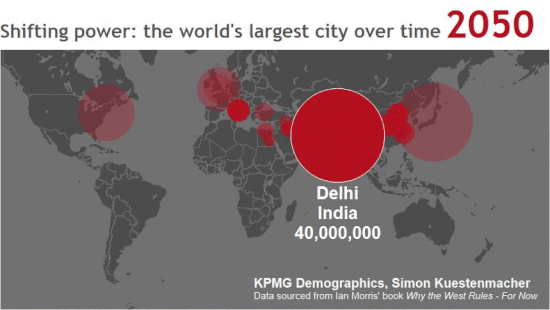
Salt and his KPMG colleagues predict that, by 2050, Tokyo will be overtaken by Delhi as the world’s largest city, with an estimated 40 million inhabitants.
*Formative Content
**first published in weforum.org
 By: N. Peter Kramer