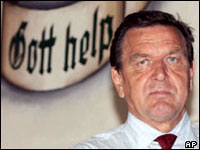
German Chancellor Gerhard Schroeder has unveiled corporate tax cuts aimed at helping Germany's 5.2 million unemployed people back into work.
He outlined the plan to cut corporate taxes from 25% to 19% in a speech to the Bundestag, the German parliament.
Chancellor Schroeder then met opposition leaders at what was labelled a crisis jobs summit, and said they had broadly agreed with his proposal.
His proposals have, however, met with a mixed reaction from analysts.
The cut in the basic rate of corporate tax will be partly financed by a rise in dividend tax.
He also unveiled a plan to invest 2bn euros ($2.6bn; £1.3bn) in the transport sector, a move which should help the construction industry.
In addition, he promised to reduce the tax burden for small business.
About 12.6% of the German workforce is unemployed, and the issue is politically very sensitive.
Mixed reaction
In his speech on Thursday, Chancellor Schroeder said: "We need to do something in the short term.
"This packet of measures is wise and desirable given the huge risks posed by international crises and external economic factors."
He also defended the set of reforms he introduced two years ago, known as Agenda 2010.
Mr Schroeder's proposals need the approval of the opposition, which has a majority in the German parliament's upper house.
He said his meeting with opposition leaders had been productive. "Of course, we couldn't agree on everything, but I think we've made good progress," he said.
Angela Merkel, leader of the main opposition Christian Democrats, said she had "a basically positive outlook" on the proposals but said they fell short of a "complete concept" for tax reform.
Edmund Stoiber, chairman of the Christian Social Union, called the meeting "worthwhile" but said without an agreement on increasing job market flexibility "it will not be possible to significantly reduce unemployment".
The proposals have also met with a mixed reaction from analysts.
IFO Institute president Hans-Werner Sinn welcomed the corporate tax cut as "courageous" but said Germany needed more fundamental reform.
Other observers said the speech sent a positive signal but failed to deliver the serious reform needed to kickstart the economy.
"A reduction in the base corporate tax rate would be positive for companies, but it is not the heart of the problem," said LBBW equity strategist Frank Schallenberger.
"The main problem is high social costs and high unemployment. I don't see any solutions to these problems so far."
Job hopes
Chancellor Schroeder's corporate tax cuts are at the heart of his job-creation plans because German business tax rates are among the highest in Europe.
Large German companies needing to cut jobs often face pressure from the German government as well as from trade unions.
He said the proposed measures would be fiscally neutral because he would find the extra money by closing existing tax loopholes.
The German economy is growing much more slowly than the UK economy. German gross domestic product, a measure of economic growth, expanded 1.6% in 2004, but is only expected to grow by 1% this year, according to economists.
However, Chancellor Schroeder's options are limited. He cannot just pump money into the economy, as the German budget deficit has for three years broken the European Union rule that it should not be more than 3% of gross domestic product.
Many large German companies, including mobile company T-Mobile, car maker Opel GM and retailer Karstadt, have also announced plans to cut thousands of jobs in the past few months.
 By: N. Peter Kramer