by
Antonio W. Romero
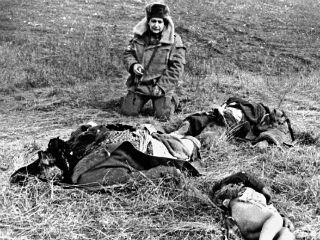
Hundreds of civilians, including women and children, were massacred when Armenian troops assaulted the town of Khojaly on 26 February 1992.
According to Azerbaijan's government, 613 Azeri civilians died, including 169 women and children. They were either shot dead by Armenian soldiers or froze to death as they tried to flee a small Azerbaijani town of Khojaly in the disputed territory of Nagorno-Karabakh region of Azerbaijan, presently occupied by Armenia.
Each year eversince, to mark the anniversary, Azerbaijanis hold conferences, stage exhibitions and reach out to international mass media to spread the truth about this darkest page of the Armenian-Azerbaijani conflict. As a matter of fact, the Khojaly massacre is an act of genocide, which has already been recognized as such by an ever-increasing number of countries and organisations.
Azerbaijanis describe how Armenian troops marched into in order to carry out ethnic cleansing of Nagorno Karabakh from its Azerbaijani minority through intimidation and subsequent occupation of the territory.
According to the reports of international media and human rights organizations of 26 February 1992, hundreds of Azerbaijani civilians were killed with extreme atrocity, most of them were murdered, some were burned alive or beheaded, while others were dismembered, and others were scalped, only because they were Azerbaijanis.
Azerbaijani refugees and displaced people who constitute today one million persons out of the total population of 9 million are still struggling as a result of this humanitarian crisis.
In fact, tens of thousands of Azerbaijani inhabitants of Nagorno Karabakh, victims of ethnic cleansing on the part of Armenia, have been thus deprived of their fundamental human rights and cannot go back to their historical homeland.
A 1994 ceasefire agreement was followed by peace negotiations. However, Armenia has rejected relevant UN Security Council resolutions demanding immediate, complete and unconditional withdrawal of Armenian occupying forces from Nagorno-Karabakh and the surrounding districts and with its destructive stance blocks the peace process carried out under the aegis of the Minsk Group of the OSCE.
On February 21, 2018, Azerbaijan’s Defence Ministry reported that only in the course of that one day Armenia’s armed forces had violated the ceasefire along the line of contact between Azerbaijani and Armenian troops more than 100 times.
Today, Azerbaijan calls on the whole international community to recognize the Khojaly genocide as a crime against humanity so that it never occurs again. Up to date, more than 15 countries in the world have recognized Khojaly genocide and international campaign “Justice for Khojaly” (www.justiceforkhojaly.org) launched by Azerbaijan to raise international public awareness of the Khojaly genocide goes on. To date, more than 120,000 people and 115 organisations have joined this campaign, which functions successfully in dozens of countries. Azerbaijan demands that those who orchestrated this massacre should be exposed and brought to justice.
As another important milestone in getting closer to this goal and to obtain legal assessment of the unlawful aggression by Armenia against Azerbaijan, in 2015, the European Court of Human Rights ruled in favor of seven Azerbaijani victims of ethnic cleansing who are deprived of their right to return to their homes and to receive compensation for their property in Nagorno-Karabakh.
Peace between Armenia and Azerbaijan is today a very distant perspective. And it seems like it will be even less achievable until the international community gives a just and genuine assessment of the root causes and consequences of the Nagorno-Karabakh conflict and starts eliminating those consequences, including through refraining from turning a blind eye to its darkest pages amongst which the massacre of Khojaly stands by far alone.
 By: N. Peter Kramer