Edition: International | Greek
MENU

Home » Events

Dikos (Konstantinos) Vyzantios 1924 – 2007

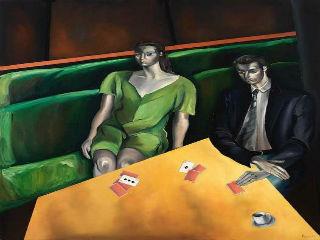
This retrospective tribute to Dikos Vyzantios is a due debt of remembrance to the illustrious painter of the diaspora who distinguished himself in the Parisian art scene for over half a century.

By: EBR - Posted: Thursday, March 7, 2019

He was the youngest among the two-hundred Greek passengers of the legendary transport ship Mataroa, whom embarked on a journey towards freedom of thought thanks to a French government scholarship and at the intervention of Octave Merlier and Roger Milliex, two philhellenes of the French Institute in Athens.   In Paris, which was destined to become his second home, he immediately felt the warmth and guidance of the hospitable circle of Dimitris Galanis. He soon became friends with Alberto Giacometti and, over time, with artists such as P. Soulage, S. Poliakoff, Vieira da Silva and others.
He was the youngest among the two-hundred Greek passengers of the legendary transport ship Mataroa, whom embarked on a journey towards freedom of thought thanks to a French government scholarship and at the intervention of Octave Merlier and Roger Milliex, two philhellenes of the French Institute in Athens. In Paris, which was destined to become his second home, he immediately felt the warmth and guidance of the hospitable circle of Dimitris Galanis. He soon became friends with Alberto Giacometti and, over time, with artists such as P. Soulage, S. Poliakoff, Vieira da Silva and others.

By Alexandra Papaisidorou*
 
Andros, 30 June – 22 September 2019
 
This retrospective tribute to Dikos Vyzantios is a due debt of remembrance to the illustrious painter of the diaspora who distinguished himself in the Parisian art scene for over half a century.
 
The son of the painter Pericles Vyzantios, he was raised in a family environment that influenced (his future choices), his intellectual and artistic pursuits in a number of ways. Aged 16, he was accepted at the ASFA. 
 
In December 1945, he was forced to expatriate in order to avoid the vortex of the fratricide divisions of the civil war. 
 
He was the youngest among the two-hundred Greek passengers of the legendary transport ship Mataroa, whom embarked on a journey towards freedom of thought thanks to a French government scholarship and at the intervention of Octave Merlier and Roger Milliex, two philhellenes of the French Institute in Athens. 
 
In Paris, which was destined to become his second home, he immediately felt the warmth and guidance of the hospitable circle of Dimitris Galanis. He soon became friends with Alberto Giacometti and, over time, with artists such as P. Soulage, S. Poliakoff, Vieira da Silva and others.
 
During his artistic career, there were three important work circles:
 
1) The abstract period which lasted until 1972 and ended with a retrospective exhibition at the Galliera Museum. (1945 – 1972)
 
2) The period of black and white drawings on paper which were exalted in an in-depth and visionary text by the philosopher Michel Foucault. (1972 – 1981)
 
3) The period of anthropocentric compositions that began in 1981, lasted to the end of his life, and were exhibited in numerous exhibitions around the world. (1981 – 2007)
 
His works are included in the collections of the largest European museums. 
 
The French government, wishing to highlight his contribution to art and considering him an important representative of the  Ecole de Paris, awarded him top honours including Knight of the Legion of Honour  (Chevalier de la Legion d’Honneur) and later Knight of the Arts and Literature (Officier des Arts et des Lettres). 
 
 
*Editor-at-large & PhD candidate of European & International Relations
 

READ ALSO

EU Actually

European Parliament challenges member-states with an additional budget increase of 10 percent

N. Peter KramerBy: N. Peter Kramer

In his weekly column, N. Peter Kramer writes how the EP opposes Commission’s proposal to cut back on traditional programmes such as agriculture and cohesion

Europe

The EU–India Deal Is Done. Africa Must Be Next

The EU–India Deal Is Done. Africa Must Be Next

The EU-India FTA deal showed Brussels can move when the stakes are high; Africa is the real test of whether Europe can protect its economic security in a more fractured world.

Business

Where Romania can build excellence: the sources of future competitiveness

Where Romania can build excellence: the sources of future competitiveness

Romania has been, for most of its recent history, a story of potential deferred. The standard account of Romanian competitiveness, to the extent one exists in international business literature, is a cost story: cheap labor, low corporate taxes, a large domestic market for Central and Eastern European standards.

MARKET INDICES

Powered by Investing.com
All contents © Copyright EMG Strategic Consulting Ltd. 1997-2026. All Rights Reserved   |   Home Page  |   Disclaimer  |   Website by Theratron