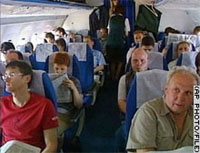
Airline passengers are putting up with "significant" drops in the supply of oxygen while flying at high altitude, according to researchers.
Just over half of all fliers analyzed had oxygen levels 6 percent lower than usual when the airplane was at maximum altitude -- a level at which doctors normally administer extra oxygen for hospital patients.
"We believe that these falling oxygen levels, together with factors such as dehydration, immobility and low humidity, could contribute to illness during and after flights," said Susan Humphreys of the Royal Group of Hospitals in Belfast, whose group conducted the research.
"This has become a greater problem in recent years as modern airplanes are able to cruise at much higher altitudes."
A drop in oxygen levels can be a contributing factor to deep vein thrombosis (DVT), a potentially fatal blood clot which is also called "economy class syndrome."
Low oxygen levels also can lead to headaches, fatigue and impaired mental performance.
"We should be giving people with ill health more advice about things they can do, such as drinking more water when they fly, to avoid problems," researcher Rachel Deyermond told the UK's Daily Telegraph newspaper.
The researchers from Belfast, Northern Ireland published their results in the May issue of Anaesthesia, a British medical journal.
They recorded the blood oxygen levels and the pulse rate of 84 passengers, aged 1 to 78, at both ground level and at peak altitude during a flight.
The research shows a "statistically significant" reduction in oxygen levels in all passengers traveling on both long- and short-haul flights.
On average, oxygen levels in passengers dropped by 4 percent by the time the plane had reached cruising altitude. A total of 54 percent of passengers had oxygen levels below this level.
Of the 84 passengers who were analyzed, 55 were on flights lasting more than two hours, while the rest were on short-haul journeys. Similar results were obtained from both groups. None of them had severe cardio-respiratory problems or required permission from their doctor to fly.
"The House of Lords and the UK Department of Transport have both acknowledged that more studies need to be carried out with respect to the effects of air travel on health, as there is little information on the physiological effects of flying on passengers currently available," Deyermond said.
 By: N. Peter Kramer