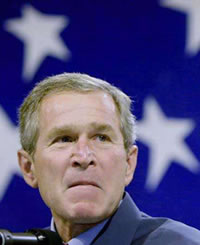
US President George W. Bush's plans for a second term received a positive response from the European Union and Japan on Friday but elsewhere there was a mixture of scepticism and downright hostility.
Bush's inauguration speech received a frosty welcome in the Arab world and authoritarian Belarus, which has come in for sharp criticism from Washington, said Bush's talk of freedom "smelt of oil."
Europe, however, welcomed US promises of a thaw in transatlantic relations. In Brussels Francoise Le Bail, spokeswoman for European Commission chief Jose Manuel Barroso, said the fact that Bush was to make the first visit of his second term to Europe signaled the importance the US government attaches to its relations with the EU.
"We welcome with satisfaction the indications that have been given of the willingness of Mr Bush for reinforced relations with the EU," she said.
Bush is due in the Belgian capital on February 22 for a summit of the NATO military alliance. He is also due to meet Luxembourg Prime Minister Jean-Claude Juncker, the EU's current chairman, and Barroso.
In his televised speech moments after taking the oath of office in a ceremony that will be remembered for its unprecedented security, Bush had warned "the rulers of outlaw regimes" to ease restrictions on dissent.
He declared that victory over terrorism required promoting freedom around the globe.
For Iraqi analyst Abdul Hussein Shaaban the US administration has lost its credibility to promote democracy after launching an invasion of Iraq that two years on has left the country lacking the most basic security.
"The United States is closing its eyes towards dictators who serve its own interests but attacks those that damage it," he added, in a reference to key US ally Saudi Arabia.
"The fact that Iraq is in chaos and under military occupation does not bode well for democracy coming to the country and to the Middle East."
Abdul Hadi Abu Taleb, writing in the Egyptian pro-government daily Al-Akhbar, asked what "values (US) soldiers are going to propagate" in countries it currently considers to be under tyrannical rule.
And an Arab professor of political science drew parallels between the words of Bush and Osama bin Laden, saying the president had made the word freedom "banal" in the same way that the Al-Qaeda leader had the word "jihad (holy war)".
"The two men have both invoked their favourite concepts without ever putting them into practice," Assad Abu Khalil, who works in the United States, told Al-Jazeera television.
He said Bush's notion that "freedom is the solution" was just as simplistic as the belief of militant Islamists that "Islam is the solution" in a region largely ruled by totalitarian regimes who reject religious extremism.
While Bush did not single out any countries for criticism, Vice President Dick Cheney said earlier that Iran was "right at the top of the list" of trouble spots, and other aides have mentioned Cuba, Myanmar, North Korea, Zimbabwe and Belarus.
Belarus' authoritarian leader Alexander Lukashenko lashed out at Bush's inauguration address on Friday, saying his former Soviet republic did not need the type of freedoms offered by Washington.
"The United States says that it has orders from above to introduce freedoms in every country," the often eccentric Lukashenko said in a statement.
"But what if we do not need this freedom, which is pouring blood and smells of oil?" Lukashenko demanded.
The EU and United States have acted in concert in tightening travel restrictions against officials in autocratic Belarus following contested polls in October which gave Lukashenko the right to lead the country of 10 million on Russia's eastern border for life.
In Japan, however, there was praise for Bush's vow to end tyranny in the world.
"It should be an ideal of the United States to spread freedom and democracy throughout the world. What is essential is that (the United States) wants to achieve it peacefully," Koizumi told reporters at his office.
"But I think he (Bush) has reiterated his existing policy not to rule out the use of force in defending h`is own country," he said, adding that this policy is also shared by US Senator John Kerry, who lost to Bush in the presidential election last November.
Koizumi set aside strong objections at home to support the US-led invasion of Iraq and then sent troops to help the battered country rebuild itself despite on-going fighting.
 By: N. Peter Kramer