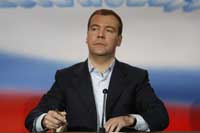
Russian President Dmitry Medvedev called for a new all-European treaty during the EU – Russia summit in Khanty-Mansiysk. The choice of the summit venue highlighted Russia’s resource wealth. Medvedev hosted his guest, Europe’s national leaders and Commission President Barroso, at the centre of the oil-rich Siberian region dubbed by its residents as the ‘Russian Kuwait’.
The summit was the opportunity for Medvedev to meet for the first time European leaders. Many of them came to Siberia hoping that the Russian president would be a more flexible and more liberal partner than his predecessor (and now Prime-Minister) Vladimir Putin.
EU External Relations Commissioner Benito Ferrero-Waldner said that Medvedev brought a ‘new impetus’ to the relation with the EU. The talks were ‘very frank’ and held in ‘an excellent atmosphere’ with the Russian President making clear that he saw the EU as ‘a genuine partner’. She said that Medvedev is more open in discussions than Putin…
Putin’s often tough rhetoric angered many of the EU’s former Soviet member states like Poland and Lithuania. Reason for them to ‘veto’ recently the start of negotiation for a new Partnership and Cooperation Agreement (PCA). As Russia supplies a quarter of the EU’s gas and even more of its oil consumption, not all EU member states became very happy with their colleagues behaviour. The call for a united position towards Russia, for instance by the European Commission, has been often undermined by countries eager to sign an bilateral energy deal with Russia, like for instance Greece, Hungary, Netherlands but also big brothers as Germany, Italy and France.
It is obvious that EU-Russia interdependence is very strong in bilateral relations, especially in the energy field. Putin has shown that Moscow is not as interested in maintaining the EU’s harmony with Russia as it is interested in maintaining Russia’s harmony with individual EU countries. It is understandable that the EU tries to talk with one voice, to obtain a stronger position in the negotiations. The biggest obstacle for that is not Russia but can be found in capitals of some memberstates.
Interesting to read in the Financial Times was the article by the co-chairs of the EU-Russia Industrialists’ Round Table, Nils Andersen and Anatoly Chubais. They stressed that the EU-Russia relationship looks finally to be getting the attention it deserves. ‘Russia is already the EU’s number three trading partner after the US and China. For Russia, the EU is both import and export partner number one. The investment relationship is growing rapidly: last year’s flow of EU investments into Russia - €17billion – represents a doubling compared with three years earlier ; Russia’s direct investments into the EU in 2007 approximated €5billion’. This explains why business leaders believe that deeper economic integration can provide the backbone for a more dynamic mutually beneficial EU-Russia relationship.
At the end of the summit, the common announcement was made that negotiations would begin July 4 in Brussels, with the old PCA to remain in force until a new one is ratified. The start of a new chapter in the often tense relationship between Europe and Russia.