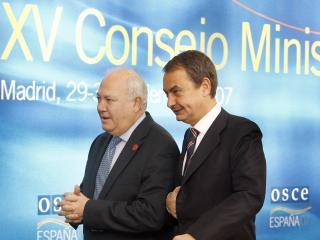
Miguel Angel Moratinos, Spanish foreign minister, said Spain will only play a supporting role to the EU's new leaders. Meeting the Brussels press for the first time in his new EU capacity on 18 December, Moratinos made it clear that with the Lisbon Treaty now in force, Spain will take a step back on the EU scene and will provide full support to Europe’s new leaders and institutions.
"I would like to state it very clearly. The engagement of the Prime minister of Spain and of the entire Spanish government is that we have new European representatives who will lead, give momentum and will steer [the Union] through the first semester of 2010," said Moratinos, who was speaking in Spanish. "Spain will not abandon its responsibility […] but we will do it with modesty, with discretion, through our work and our support. This is what we have decided and what we have agreed with the Permanent President, with the High representative, and I can say that there will be no competition, there will be complementarity, there will be support to these new institutions and personalities," he stated.
Moratinos presented his country’s priorities, which largely repeated a recent presentation by Spain’s Secretary of State for EU Affairs Diego López Garrido.
Facilitating Lisbon Treaty innovations
The Spanish minister said that permanent Council President Herman van Rompuy will chair EU summits and speak to the press, adding that it would be his decision to invite Spanish Prime Minister José Luis Rodríguez Zapatero when he considers it necessary. Speaking about his own role, Moratinos made it clear that Catherine Ashton will chair the meetings of EU foreign affairs ministers. Only the informal Gymnich ministerial meeting in Cordoba, due on 5-6 March, will be co-chaired, he said. As part of its ambition to facilitate the full implementation of the Lisbon Treaty, Moratinos said Spain will do its utmost to quickly integrate the additional 18 MEPs in the European Parliament. The current European Parliament was constituted with 736 MEPs but the Lisbon Treaty foresees that there should be 751 MEPs. He also said Spain will work with the Commission to adopt a regulation on the so-called "citizen's initiative" created by the Lisbon Treaty, which allows voters to trigger a process for adopting new EU laws based on a million signatures.
'2020 strategy' may change name
As to the future of the EU's flagship Lisbon Agenda for growth and jobs, which expires in 2010, Moratinos said the new strategy had not yet been given a definitive name. In its consultation for a new post-2010 strategy, the European Commission had suggested naming the new policy agenda "EU 2020", in reference to the new target date for achieving the EU's objectives of growth, jobs and environmental protection. But it remained unclear whether Spain was considering naming the new Strategy after the city of Valencia, where the new policy is due to be adopted on 25-26 March. Moratinos caused some controversy, saying that the major shortcoming of the Lisbon strategy was the lack of a binding mechanism to monitor the performance of member countries on issues as diverse as employment or innovation or social inclusion. Asked to elaborate, he apparently stepped back, saying Europe was only "at the beginning" of this process. "My English is not so perfect. When I say ‘binding’, it can mean very binding, less binding… I can say it in Spanish better," he cautioned.
Enlargement agenda
On the EU's enlargement to new countries, Moratinos made it clear that Spain was standing behind Croatia’s accession bid, saying it would seek to close the negotiation process in the first half of 2010. He also said efforts would be made towards solving Macedonia's "name dispute" with Greece, allowing for accession negotiations to start. He also said he favoured Turkey’s progress in the negotiations, which are currently blocked because of Turkey's refusal to open its ports and airports to Cypriot vessels and planes. He said however that he was optimistic with the ongoing talks for the reunification of the divided island, and that his country had excellent relations with both Nicosia and Ankara. On Turkey, he added that his country had initiated together with Turkey an "Alliance of Civilisations" initiative, and was going to move the agenda further in the next months. The Spanish minister also indicated that Serbia would present its accession application very soon, and that his country is not opposed to the move, in spite of the fact that the present legal base of EU-Serbia relations, the Stabilisation and Association Agreement (SAA), is not yet in force due to opposition from the Netherlands.
 By: N. Peter Kramer