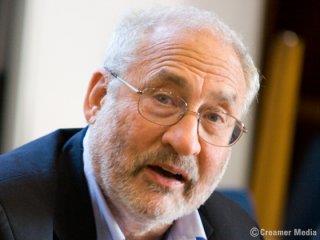
He ruled out the prospect of economic collapse in Greece and also said the high interest rate spread for Greek bonds was excessive.
Stiglitz did not volunteer specific measures that the Greek government might take to correct the problems, noting only that this required structural reforms and that a successful policy should find a good balance between reducing the deficit, stimulating the economy and dealing with its structural weaknesses.
Asked whether salaries in Greece should be cut, the economist asserted that pay reductions did not general have a positive impact on reducing public deficits and pointed to the case of Ireland, where cuts in wages had failed to the anticipated results.
Commenting on the European Central Bank, Stiglitz said it was a paradox that the ECB was prepared to lend to banks at effectively zero interest but was not prepared to do the same for EU member-state governments.
Greek PM announces new measures to tackle crisis
In the meantime, Prime Minister George Papandreou, addressing the Greek people on Tuesday evening after holding meetings with political party leaders at the Maximos Mansion during the day, announced new measures to tackle the economic crisis.
Papandreou stressed that the country was at the centre of speculating games that have the euro as the ultimate target and used Greece as a weak link. He added that the annulment of all these attempts through which leading the country down a cliff is being attempted, is a national duty and stressed that the government is determined to take all measures to prevent such development.
"We must act immediately and decisively," he said and mentioned that on Wednesday the European Commission will be considering the country's stability programme positively, a programme that, as he said, "will tidy up the economy."
Among the measures announced by Papandreou are an increase in tax on distributed profits that are not reinvested, the taxation of dividends in the way that incomes are taxed and an increase in the taxation of offshore companies.
Papandreou also stressed that it will be necessary in 2010 for public sector revenues to increase and announced that one of the measures that will bring revenues quickly will be an increase in the taxation of fuel.
He further announced that the bill on incomes policy will be tabled in Parliament soon, issues related to high incomes in the public and wider public sector will be handled and that increases that will be given will not move further than salary maturity. He said that all this will also concern local administration and the wider public sector.
The prime minister went on to say that the country's lost competitiveness must be tackled and called on employers and employees to contribute in this direction.
Referring to the social security system, he said that it will be fair and gave an indication of decisions which, as he said, have been implemented in other European countries and concern, among other things, an increase in pensioning age limits.
The prime minister stressed that the government is fully aware of the difficulty and crucialness of the situation, as well as of difficulties facing the Greek family. He added that for this reason it will move with a feeling of justice, that the measures may be painful but the government's effort is aimed at stopping the country's course towards the abyss.
Papandreou promised that he and the government will do everything possible to support the weak, to support the average Greek family and the younger generation. He added that "there is no ground for strikes, work stoppages and blockades since, as he said, we must all wage the struggle together".
He also stressed that the more powerful must contribute more and, in parallel, the weak must be protected more.
Lastly, the prime minister pointed out that the government is here to guarantee all this and expressed certainty that the citizens are also here to help the country achieve its targets. He stressed "we know the abilities of Greece and Hellenism" and underlined that "I am sure that we shall succeed."
 By: N. Peter Kramer