What is her problem? Is it her lack of experience in foreign affairs? Is it the awkward situation of her current function? Or is it the turf war between the European Commission and the 27 memberstates in the European Council? The answer is yes on all three questions!
Ms Ashton has indeed little foreign policy experience. And the function of the EU’s Foreign Policy Chief, one of the topics of the Lisbon Treaty, is without any doubt an awkward one. She is a representative of the EU 27 memberstates, the European Council, what has to be combined with being one of the 27 members of another European institution, the European Commission.
Until the Lisbon Treaty recently came in force, the Commission has had control of most EU foreign policy abroad. But the new treaty brought a novelty, the European External Action Service (EEAS), a full dressed EU diplomatic corps. Unfortunately the new treaty is silent on details about the new service. The Commission and the memberstates, the Council, have to work out who should control the new body. Of course it is Lady Ashton’s responsibility, but as European Commissioner for Foreign Policy or as the representative for Foreign Policy of the European Council?
A bitter power struggle has started. The EU memberstates are determined to exert their influence over the new service, and were furious when Ms Ashton allowed European Commission President Jose Manuel Barroso to appoint, under old rules, his closest aid to the key post of EU Ambassador in Washington. In a reaction, the foreign ministers of UK and Sweden wrote a letter calling for the memberstates ‘to play a full part right from the beginning’.
This week, in an appearance in the European Parliament, Lady Ashley hit back at her critics by blaming rivalry among the EU institutions for the slow progress in establishing the new EU diplomatic service: ‘people have to adjust their mental maps and institutions have to find their new place’. It became clear that the parliament wants to have a new place as well. Though the Lisbon Treaty does not give the EP power over the EU foreign policy, it does extend their competence over the EU’s budget and staffing rules. Both have to be amended to set up the European External Action Service…
EU memberstates and Commission mangle Lady Ashton
Life as the first EU’s Foreign Policy Chief under the Lisbon Treaty is not easy for Lady Catherine Ashton, a former leader of UK’s unelected House of Lords who then, as successor of Peter Mandelson and till the appointment for her current position served as European Commissioner for Trade.

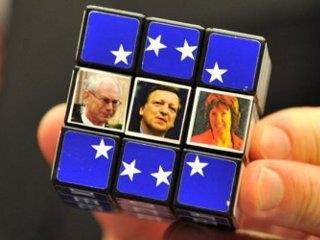
This week, in an appearance in the European Parliament, Lady Ashley hit back at her critics by blaming rivalry among the EU institutions for the slow progress in establishing the new EU diplomatic service.