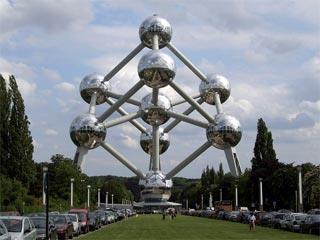
Given the "phenomenal" cost of relocating, the city constitutes "an ecologically defensible capital of the European Union," a report authored by Philippe Van Parijs and Jonathan Van Parys for the Brussels Studies think-tank concludes.
Discussions on the location of Europe's HQ were instantly characterised by stalemate and leaders never formally designated Brussels as EU capital, the authors recall.
The lack of consensus in choosing Brussels as the home of EU capital in the first place makes it difficult to imagine that 27 countries would reach agreement on an issue that proved impossible for six to resolve, they argue.
Moreover, as the current seat of the European institutions, Brussels also holds a key advantage over potential other locations in that many transnational organisations are already headquartered there, according to the study.
"Irretrievable" investments made in the Belgian capital by the EU institutions and the "countless" organisations located there due to its European function, including permanent representations of EU member states, industry associations, consultants and lobbyists, mean that any desire to move would "come up against enormous internal and external resistance".
Indeed, many of the actors involved in EU policymaking rely on networks built up in Brussels over the years, "because it is important for them to be located near similar organisations which are already located there due to the proximity of the European institutions".
Prague, Frankfurt, Luxembourg main challengers
Considering the case for moving the EU's headquarters, the Brussels Studies report defines four "centres of gravity" - 'diplomatic', 'demographic', 'metropolitan' and 'civic' - that determine whether a city makes a good capital.
The researchers conclude that Prague comes first from a diplomatic viewpoint in that it is the most centrally located in relation to the EU's other national capitals.
Frankfurt leads from a demographic point of view, as defined by minimising the total distance to the EU's biggest cities, while Luxembourg comes top from a metropolitan standpoint after the demographic figure has been modified to take into account the millions of people who live in the metropolitan areas surrounding those cities.
Brussels comes first from a civic viewpoint, which ranks the intensity of transnational activity in Europe's cities.
Making the case for maintaining a physical seat for the EU institutions, the report argues that despite the rise of Skype and Twitter, there is a growing need for decision-makers to converge on "a small number of places – and preferably just one place [to] communicate, negotiate, collaborate and take action" in face-to-face meetings.
"The growing importance of ecological considerations will not eliminate the need for a hub city for intense transnational activity," the researchers predict, concluding that location is the most important factor in choosing an EU capital.
Cost of relocating prohibitive
However, "phenomenal" financial costs linked to the explosion in real-estate prices that relocating to a new city would trigger, coupled with the ecological costs of new construction and commuting during the transition phase and the fall in value of property in Brussels, reduce the strength of arguments in favour of a move, the researchers explain.
"Due to the lasting advantage [Brussels] has established for itself as the civic centre of gravity, combined with its proximity to the demographic and metropolitan centres of gravity, there is no doubt that as regards its location, Brussels constitutes an ecologically defensible capital of the European Union," the study concludes.
Source: Brussels Studies think-tank
 By: N. Peter Kramer