by Emma Collet
As living and working conditions in Russia deteriorate for young workers from former soviet republics of Central Asia, the European Union is funding migration centres in this historically Russian-dominated region, aiming to address labour shortages on the continent.
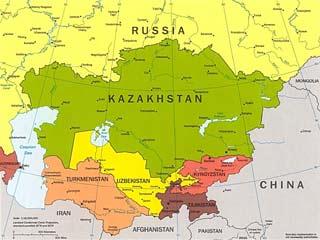
In December 2025, Sherzod*, a 40-year-old Kyrgyz citizen, left the Russian region of Samara, where he worked in construction, and returned to his home country of Kyrgyzstan, a small, landlocked, mountainous nation squeezed between Kazakhstan and eastern China.
In his rural village, a few dozen kilometres from the main city in southern Kyrgyzstan, Osh, he is now struggling to find stable work. Yet returning home felt unavoidable as Sherzod says he no longer wanted to risk being sent to the front in Ukraine.
Russian authorities did not offer him a direct combat role, but proposed work supporting logistics operations at bases used by the Russian army in Ukraine.
“They needed additional staff in warehouses, kitchens and transport,” he said, speaking anonymously.
He also recalls recruitment campaigns targeting Kyrgyz migrants and other workers from Central Asia, alongside episodes of police violence and xenophobia against migrant labourers, many of whom live in precarious conditions in Russia, as Human Rights Watch reported in 2025.
Today Sherzod – like thousands of Kyrgyz workers – is considering turning away from Russia, now widely seen as too dangerous, and looking towards Europe instead.
“I would be interested in working as a driver or factory worker in Poland or Germany. People say that if you speak the language, people understand you. That’s why I’d like to study in Germany or another country,” he explains.
Russia no longer the natural destination
For decades, Russia was the obvious destination for Central Asian workers seeking employment abroad. Salaries there were sometimes up to five times higher than those available in their home countries, whose economies remain poorly diversified and offer limited opportunities for young people.
In 2025, around 14% of Kyrgyzstan’s GDP came from remittances sent by migrant workers, most of them based in Russia. In neighbouring Tajikistan – the poorest country in the region – nearly half of the 2024 GDP depended on such transfers. According to the Asian Development Bank, that share is expected to decline to around 37% in 2025 – still an extremely high level.
Since the war in Ukraine began, Russia is no longer widely seen as an economic “El Dorado.” Authorities are increasingly moving to curb the inflow of Central Asian migrants despite worsening labour shortages, according to the NGO Insan-Leilek Public Foundation.
Tensions escalated further after the Crocus City Hall terror attack near Moscow, which resulted in the death of at least 145 people and was carried out by four Tajik citizens claiming allegiance to Islamic State Khorasan Province. The attack fuelled suspicion toward Central Asian migrants.
At the same time, the Russian army has been recruiting foreign nationals directly. The Ukrainian project Khochu Zhit’ (“I want to live”) estimates that at least 2,439 Uzbek citizens, 1,926 Tajiks, 1,432 Kazakhs, 843 Kyrgyz and 360 Turkmen are currently fighting in Ukraine.
As a result, migration flows from Central Asia to Russia have begun to decline for the first time.
In Kyrgyzstan, the number of migrants travelling to Russia dropped from around 600,000 in 2023 to 350,000 in 2025. In Uzbekistan, the figure fell from 1.2 million to around 700,000. The decline in Tajikistan is less pronounced but nonetheless noticeable: an IOM report states that while 673,285 Tajiks left the country in 2023 to seek work, mostly in Russia, the number fell to 618,097 the following year.
Europe becoming more attractive
While other destinations such as South Korea and Turkey are gaining ground, Europe is also becoming increasingly attractive – and the European Union is seeking to accompany this shift.
Brussels has funded three migration resource centres in Central Asia under the PROTECT project, complementing existing centres in Afghanistan and Pakistan. Supported by a €5 million EU budget, the program is implemented by the International Centre for Migration Policy Development (ICMPD), an intergovernmental organization established in 1993 and primarily financed by the EU.
Their objective is to improve access to reliable information for potential migrants, promote safe and legal migration pathways, and raise awareness of the risks associated with irregular migration and human trafficking.
In the Osh region, located in the densely populated Ferghana Valley with a population of nearly 1,5 million, data show a 60% decline in job requests linked to Russia between the first and second quarters of 2025.
“Migrants returning from Russia to Kyrgyzstan often consider changing their migration routes,” says Raushan Botolalieva, a project officer at the Osh centre. Many are reluctant to return to Russia, fearing they could be recruited or pressured into supporting military operations linked to the war in Ukraine.
Since the migration resource centre opened there in 2024, it has assisted more than 12,000 people. Among them, 924 individuals have received guidance on job opportunities in European countries, while 4,512 people have completed pre-departure training for seasonal work in the United Kingdom.
Limited access to the European labour market
For Radim Zak, ICMPD’s regional representative in Central Asia, “the region has a young and active population that Europe will need in the coming years, particularly in services and agriculture.”
“The reconstruction of Ukraine could also play an important role,” he adds.
Yet work visa procedures remain lengthy and complex.
“Government-to-government relations take time,” Zak notes. “Central Asian officials are sometimes frustrated by the slow pace of progress, even though a positive dynamic was observed under the Polish presidency of the EU.”
For now, Central Asian migrants remain a small presence in the EU labour market. In 2023, they represented just 0.8% of valid residence permits in the European Union, according to an ICMPD study.
However, since 2021, labour migration has become the dominant channel, accounting for 73% of new arrivals. The main destination countries are Poland, Lithuania and Hungary, where migrants mostly work in low-skilled jobs in construction, agriculture and industry.
Located at the crossroads between China and Russia, the region has become increasingly strategic for Brussels since the war in Ukraine. Relations between the EU and Central Asian capitals could deepen further if access to the European labour market expands for citizens from the region.
*Name changed to protect anonymity.
**Published first on Euractiv.com
 By: N. Peter Kramer