by Rym Momtaz
The cost of supporting Ukraine for “as long as it takes” is coming home to roost at the ballot box. And nowhere could the impact be as consequential as in France.
For more than four years, European leaders, including French President Emmanuel Macron, have been repeating this mantra. They bet that their risk- and pain-averse constituencies would accept the conflict’s increasing impact on living costs because it meant keeping war from coming to their footsteps.
But with the inability of the state to stem the compounded effects of the Ukraine war with the American-Israeli war against Iran, strained public finances, and an increasingly aggressive Russian campaign of sabotage, arson, and other hybrid attacks closer to home, that belief doesn’t seem to be holding anymore for a plurality of French people.
In France, 40 percent of survey respondents trust far-right leader Marine Le Pen the most to “fight against potential hostile actions by Russia toward France,” with Jordan Bardella, her protégé and the National Rally (RN) party’s president at 41 percent, according to a wide-ranging Harris Interactive poll published in September, 2026.
That is eight points ahead of the next closest personality, former prime minister and presidential candidate Édouard Philippe.
This could have serious repercussions for the EU’s posture against Russia. And European leaders who chose to drip feed big-ticket military equipment to Ukraine—instead of front-loading the weapons that could have had more impact faster—may come to regret their bet that Russia’s economy would buckle under sanctions pressure before their own democratic cycles could catch up with them.
While European sanctions and military support for Ukraine’s targeting and deep strikes are causing pain in Moscow, election cycles at home are dangerously close to overtaking the timeline. This was prominently evidenced by the German far-right’s recent strong results in state elections and Le Pen’s current lead in the French polls.
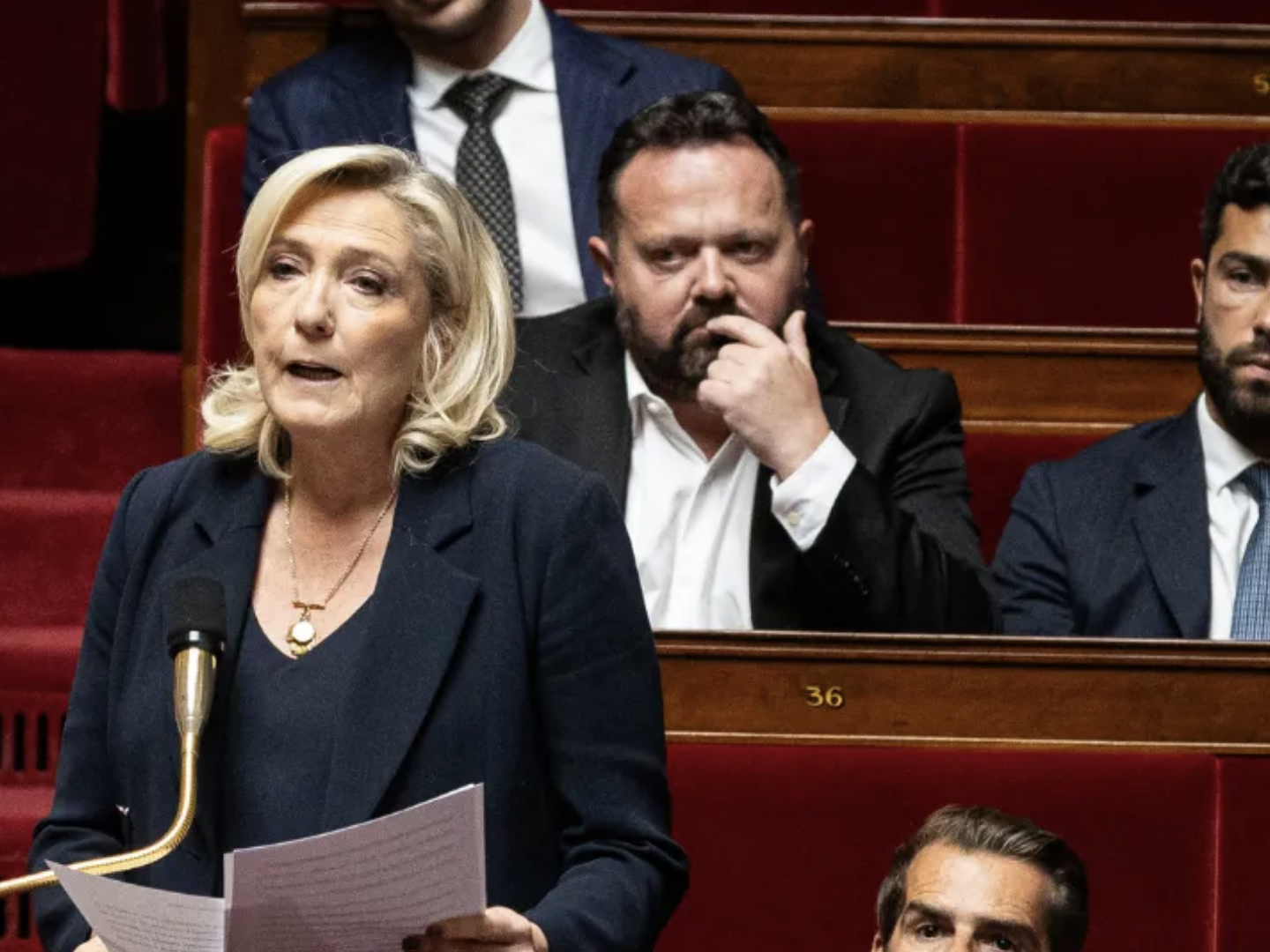
She is currently the runaway front-runner of the upcoming presidential election and has been clear that, if elected in 2027, she would halt French military support to Ukraine and suspend sanctions against Russia.
Instead, she promises to bring peace through diplomacy and a belief that once Russia sees France quit its punitive measures, it would finally engage in a way it has so far refused to, despite many diplomatic overtures over the years.
Regardless of the practical obstacles, the narrative is clearly gaining appeal among voters. To be sure, Le Pen’s pole position in the presidential race is not mainly driven by her positions on the war in Ukraine. But, given the specificity of the questions in the Harris poll, they shouldn’t be underestimated either.
Russia’s threat to Europe and France is not in question. The same poll finds that 60 percent consider Russia to be a threat to the country, including 55 percent of RN supporters.
What is in question is how best to counter—or rather, manage—it. And while some might consider Le Pen’s position toward Russia to be appeasement, there are multiple factors contributing to the appreciation of her position by a plurality of voters.
The inability of the French state to decisively intervene, diplomatically or militarily, to broker an end to the war in Ukraine stems from its inflationary impact as well as that of the war in the Middle East. The need for energy subsidies, or to physically secure energy supplies in the Black Sea and Middle East, is now playing out in the presidential election.
In a statist country like France, for the government to be so helpless is unacceptable. But with public debt on track to exceed a record 120 percent of GDP, the fiscal space is simply not there. As a result, Macron was forced to make a highly unusual admission of both financial and diplomatic powerlessness in a televised address on September 18, 2026: “The situation is the consequence of the geopolitical situation, and we have constraints related to public finances.”
Coming from the same president who vigorously pursued diplomatic initiatives, championed the so-called “coalition of the willing,” and tackled the impact of COVID-19 with a “whatever it costs” policy, it is an arresting change of fortune, especially for a country so taken by notions of grandeur.
The French people’s disaffection with the Ukraine strategy has been building.
In February, support for continued military aid to Ukraine fell below the 50 percent bar for the first time, compared with 65 percent at the beginning of Russia’s full-scale invasion.
Beyond the real and rising cost of living concerns, other more ideological factors could help explain the growing French reticence. Some—especially in the political, intellectual, and artistic class—see France and Russia as kindred former empires with a special shared history and role in steering the affairs of the continent. For another group, France has a unique role to lead a third way that would be an equilibrium between the United States and adversarial powers like Russia or China. And a third group is viscerally anti-EU, anti-NATO, anti-Washington, and as such blames NATO for the war instead of Russia.
Both candidates currently most likely to be in the presidential run-off in May, 2027—Le Pen, and the far-left, anti-NATO Jean-Luc Mélenchon—hold a mix of the aforementioned ideas and, if elected, are likely to try to influence the EU’s collective position in that direction.
*Published first on Carnegie - Strategic Europe
 By: N. Peter Kramer