The uncharacteristically blunt behaviour of Commission President Barroso was remarkable. He permitted himself to attack Chancellor Merkel in public twice. First he blamed Germany for waiting too long to back proposals to rescue Greece and a few days later he called Merkel ‘naïve’ because the proposal changing the Lisbon Treaty to create rules to punish member states who break the single currency rules. The German reaction was no more than a shrug of the shoulder…
The Commission had (and has) the power of initiation to propose EU regulation to the European Council (the government leaders of the 27 member states), and the European Parliament. The financial and economic crisis has changed the extent to which this power is used. Economic malaise feeds protectionist and nationalist tendencies. Barroso and his Commission didn’t measure up when there was a need for important European initiatives during the crisis. The government leaders lost confidence in the Commission and positioned themselves behind the steering wheel. Maybe this was not the case for all government leaders but, without any doubt, it was for the strongest amongst them: Merkel and Sarkozy.
The Lisbon Treaty, which strengthens the position of the European Council and the European Parliament to the detriment of the Commission, intensified this development. The pressroom of the Berlaymont, the Commission’s mainbuilding, was not even half full when Barroso presented the Commission proposal for supervision of credit rating agencies under attack over their role in the Greek debt crisis. At the same time most correspondents sat in the Parliament where MEP’s were deciding about a Commission proposal for restricting the derivates trade. And across the street from the Berlaymont, EU Council President Van Rompuy huddled with the member states on the most important political question of the moment: how will the Eurozone be governed in the future?
When the Commission fell out of favour with Germany and France, Van Rompuy got the chance to take over. Nobody would say that the Commission is irrelevant, but its role is reduced to be executor and secretariat. These days, Van Rompuy is the political engine, thanks to Merkel and Sarkozy.
Not everybody in Brussels is happy with the powershift from the Commission to the Council with its 27 national leaders. Especially not the Eurofederalist Guy Verhofstadt, who once wrote a book called ‘The United States of Europe’, a plea for a centralised European Union with a strong Commission, no space for nationalist behaviour and a European taxation system. Verhofstadt was a longstanding Prime-Minister in Belgium and the last one to win confidence on both sides of the language border in his country. Twice he was a candidate himself for the Commission Presidency. But in 2004 he lost the race to Barroso, former Prime-Minister of Portugal and in 2009 to … Barroso again, who won a second term. Now Guy Verhofstadt is the leader of the Alliance of Liberals and Democrats for Europe (ALDE), the third biggest group in the EP.
In the middle of June, twice on the same day, Verhofstadt entered the limelight standing in the breach for the European Commission. First he lectured the EU finance ministers that they ‘have correctly identified the problem, a lack of governance, but failed to spell out the necessary solution’ by choosing a peer review based mechanism to bring discipline to macroeconomic policy-making in the member states. Verhofstadt’s choice was that ‘the Commission or the ECB, rather than the Council are charged with making objective assessments of the state of the national budgets’.
Later that day, in an article in The Parliament magazine, the ALDE-leader said that it would be better Commissioners Andris Piebalgs and Stefan Füle were to play the role of deputies of Catherine Ashton, EU High Representative. But it is clear the Council will never accept that Commissioners represent Baroness Ashton when dealing with foreign affairs and security policy, that is the prerogative of the Council!
Guy Verhofstadt: the Saviour of the European Commission?
Former long standing Belgian Prime-Minister Guy Verhofstadt is using his current position as President of the Liberal Group in the European Parliament, to play patron to the EC, which has lost power since the Lisbon Treaty came into force and also due to its lack of ambition and sufficient quality

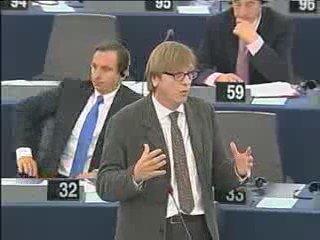
Verhofstadt was a longstanding Prime-Minister in Belgium and the last one to win confidence on both sides of the language border in his country. Twice he was a candidate himself for the Commission Presidency.