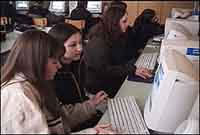
Bulgaria has launched a three-year project that will set the stage for the transition to a knowledge-based economy and help the country catch up with Western Europe in terms of modern information and communication technologies. The objective is to ensure that all students have the chance to master digital skills and knowledge, enabling them to search for and find the information they need and use it in the process of education, making them more competitive when they enter the labour market.
Bulgaria has launched a three-year programme that will see all schools in the country supplied with computers and access to high-speed Internet. The project, dubbed i-Class, is part of the country's overall efforts to bridge the digital divide with the countries of the European Union, which Bulgaria is scheduled to join in January 2007.
Deputy Prime Minister and Minister of Transport and Communications Nikolay Vassilev announced the official start of the programme on 7 March, days after lawmakers adopted a national strategy and action plan for the introduction of information and communication technologies (ICT) into the Bulgarian school system.
The objective of the strategy is not simply to supply all schools with computers and to provide access to the Internet to all students, but -- more importantly -- to ensure that all have the chance to master digital skills and knowledge. The overarching goal of the strategy is to create a substantially new environment, in which the students are able to search for and find the information they need and to analyse and use it in the process of education, which will make them more competitive in the labour market.
The measures envisioned in the strategy include also the creation of an information network, an educational portal, distance learning platforms and a knowledge base for all disciplines, as well as training courses for teachers as a step towards the incorporation of ICT in all school subjects.
At the end of February last year, the European Commission (EC) issued its eEurope Progress Report 2004 on the EU member and candidate countries' achievements in information society development. According to Vassilev's ministry, the general conclusion was that EU candidates Bulgaria and Romania had made the least progress among all countries surveyed. The report also highlighted a critical gap between Bulgaria and mainstream Europe in respect to the use of ICT in the system of education.
A new EC report of February this year places the share of Internet users in Bulgaria at 19.2 per cent of the country's population of 7.9 million -- behind all EU member states, but ahead of Turkey and Romania. According to the report, "eInclusion Revisited: The Local Dimension of the Information Society," Internet penetration in the 25 current EU members stands at an average of 41.4 per cent of the Union's population. The figures, however, are based on a Eurobarometer survey in July 2003 and will likely have changed since.
"Education, age and income appear to be the most important variables along which the digital divide is configured. Gender related and geographical factors [rural/urban divide] show a still relevant, but relatively lesser influence on exclusion from Internet use," the report notes.
Seeking to bridge the gap separating Bulgaria from mainstream Europe, the transport and communications ministry launched a nationwide, i-Bulgaria programme in April 2004. Its principal goal was to create the basis for the development of the three main pillars of the information society: access to ICT for the majority of the Bulgarian citizens; introduction of ICT at all levels of education; and development of a competitive national ICT sector.
As part of the implementation of that programme, a total of 600 computers were installed in 50 schools in 2004. Towards the end of the year, the government provided 5m euros for the purchase of another 7,700 computers that have been installed in 750 schools with more than 400,000 studying in them.
According to Vassilev, Bulgaria will spend about 70m euros in the implementation of the 3-year i-Class programme. Nearly a third has been set aside for the purchase of 20,000 new desktops this year, when nearly 2,500 new special classrooms for computer training will be built, each equipped also with a server, a printer and a scanner. More computer labs will appear in 2006 and 2007.
In addition, nearly a third of the 3,300 schools in the country will have access to high-speed Internet by the end of this year, and the rest by the end of 2006. In 2007, all school computers will have access speeds on average twice as fast as they have now.
The i-Class programme also envisions specialised training courses for nearly 3,300 computer lab directors and for about 90,000 teachers, so that they may acquire the knowledge and skills needed for the appropriation of ICT in the teaching process.
Provision of adequate infrastructure and technology, especially to underserved or remote areas and groups at risk of exclusion, is also one of the measures EU experts consider crucial for guaranteeing European standards of social inclusion and regional cohesion.
Co-ordinated public intervention at different levels -- European, national, regional and local -- as well as the constant commitment of governments, the private sector and civil society are still needed to ensure the evolution toward a more sustainable and inclusive knowledge society, the February report also notes.
One key condition for the success of a digital inclusion strategy, EU experts stress, is that it rests on a context-based approach, whereby targeted groups are considered within their geographical, social and cultural environment.
 By: N. Peter Kramer