With the Lisbon Treaty finally adopted the provisions for this new function came into force and the Flemish conservative, than prime-minister of Belgium, made his way into this brand new chair. As always with new functions, the first person to fill such a place is to shape it. Always an original Haiku at hand, Van Rompuy put himself to work proving his self-proclaimed “quiet consistency“.
After exactly one year now, we can make the assessment of his first achievements. We remember the euro-crisis and EU power struggle about economic coordination and governance. Assessing the EU’s governance over the past year, we cannot avoid the question: who is to do what, the European Council President or the President of the European Commission?
In article 15 (6) of the Treaty on the European Union, we find the duties of the European Council president. Besides chairing and driving the work of the European Councils forward, finding consensus among the national leaders and report to the European Parliament, he is to ensure the preparation and continuity of the work of the European Council in cooperation with the President of the Commission. It is this last duty that makes one wonder who is the real EU boss in town?
The real powers are still with the President of the Commission leading the largest EU institution, guardian of the treaties and the acquis communautaires, employing about 33.000 people and having the sole right of initiative to propose legislation.
Under the Treaty of Lisbon, the European Council became an EU institution tasked to provide the Union with the necessary impetus for its development and defines the general political directions and priorities thereof. It will not exercise legislative functions which it urges the European Commission to come up with and leaves adoption of legislation formally to the European Parliament and the Council of Ministers.
For the simple observer the distinction between the European Council and the Council of Ministers already remains unnoticed. Worse is the accountability. Since the European Council consists of the Heads of State or government of the Member States, together with its President and the President of the Commission the feeling is that there are two captains on “Ship Europe”. Sure, the institutions all have their own competences and presidents but for the strategic political directions and priorities there are both the European Council conclusions decided by the leaders of the Member States and the European Commission strategy and programme decided by the Commissioners and its president. José Manuel Barroso, now in his second mandate, first was left alone with the political instructions given at EU and now sees a new high-level official permanently holding office at the other side taking the lead at all arising strategic political questions such as the euro-crisis. The Lisbon Treaty has pushed the Commission President in a more executer’s role and the new permanent European Council president in pole position vis-à-vis the media. The Commission President, who already sits in the European Council, could however very well be appointed as its President. This would allow the European Council to combine the position, with its powers, of both EU institutions into a single President of the European Union.
In term of locations, the European Council and its General Secretariat are still based in the same Justus Lipsius builing as where the Ministers of the Council meet. Van Rompuy & co will however move next door to the European Councils new premises once finished, estimated for 2013. This is facing the Commission’s Berlaymont building at the other side of the Brussels’ Wetstraat/Rue de la Loi. Why not combining the two offices?
Even on foreign affairs, the Commission President alongside the President of the European Council and the High Representative (which sit in his Commission) represent the EU abroad, it’s pure duplicating. Also abroad even with the Lisbon Treaty the question is raised: who is the real boss of the EU?
Barroso was appointed by the European Council and the European Parliament for a five year term and is responsible to Parliament which can censure him. This somehow democratically elected EU body is able to appoint the Commission President and force him out. The goal of the Lisbon Treaty was to make the EU work more efficiently but creating a permanent President of the European Council larger member states, such as France, Italy, the UK and Germany, seek to sideline the Commission president’s role. Van Rompuy and Barroso are deemed to compete each other due to vague language in the treaty and the shaping of the European Council Presidents role. Some analysts see Van Rompuy as the "strategist" and Barroso as a head of EU government but during the recent euro-crisis Van Rompuy saw the Commission as dealing with the content of the plan and the European Council as dealing with the means and implementing it.
Having said all that, Van Rompuy’s present term will end in 2012 but could be extended with another two and a half years. Barroso’s 2nd five year mandate runs onto 2014. This situation will bring the possibility of double-hatting back to the table. It was suggested at the Convention on the Future of Europe, but might be the solution in 2014. It would clarify the misty political leadership and prevent the institutions from competing. It does not require a treaty change when the posts are not merged but only taken care of by the same person. By the time Barroso and Van Rompuy’s terms are up, and some may already be dreaming about it, a certain someone from one of the bigger Member States might be very interested to step into a double-hatted super EU President job.
That will be the EU’s boss!
* Niels Schreuder is an EU Affairs observer based in Brussels and secretary-general of the Belgian section of the Association of European Journalists
Who’s the real boss in the EU?
Now a year ago, Herman Van Rompuy was designated to be the European Union’s first permanent president. For decades the European Commission president had been Europe’s chief executive and the boss in town.

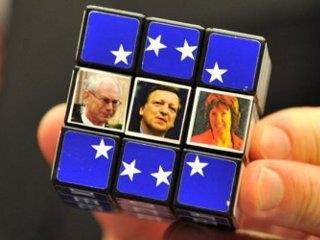
Sure, the institutions all have their own competences and presidents but for the strategic political directions and priorities there are both the European Council conclusions decided by the leaders of the Member States and the European Commission strategy and programme decided by the Commissioners and its president.
 By: N. Peter Kramer