by
Denis MacShane*
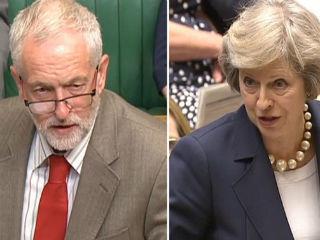
Unlike Theresa May, Jeremy Corbyn does listen to advice and, in the interest of electoral success, is willing to change his act.
Just consider that he accepted professional media training and started to wear a suit and tie and shoes, instead of sandals and jeans.
His core didn’t change
Corbyn is liable to have remained the 68-year-old 1968er — a pacifist, anti-globalization, anti-market leftist in the manner of Podemos in Spain, or Syriza in Greece. Indeed, the Narcissus of the Euroleft, Yanis Varoufakis, at one time became his economic adviser.
As with Bernie Sanders or Jean-Luc Mélanchon, there is an audience for such prophets preaching against the evils of modern economics.
Attractive mix
Corbyn’s advantage is that he can appear quite affable – and stay away from tone-deaf ideology when he wants to.
During the campaign and various TV debates, he scored good points about a UK needing to opt for more inclusiveness and smart government programs that help the lower 70% to get ahead.
Plus, he ages well. He may be a socialist firebrand, but that was definitely not the air he gave off during this campaign. He came across as a polite, middle-class pensioner making good points about the evils of the modern world that many agreed with.
Limits to his rise in the polls
This does not mean Jeremy Corbyn can become prime minister. The 101-seat difference between Conservative and Labour will ultimately not vanish.
But Mrs. May is not going to crush and eliminate Labour — and Corbyn’s political honour is thus saved.
A weekend opinion poll said the gap between the Conservatives and Labour had closed to just 6 points. But that would still translate into a gain of 33 Tory seats for Mrs. May.
Both leaders lose this election
The curious thing about the UK’s June 2017 election is that neither of the two big parties’ leaders can emerge a winner.
Corbyn cannot lead Labour to power, but May cannot show the nation is united behind her and willing to endow her with a massive majority in the Commons.
Consequences for Europe?
For the EU27, the election changes nothing. On June 9, Mrs. May will be back in Downing Street after this unwanted election. Then, the question of Brexit can no longer be avoided.
The two core questions are crystal clear:
1. Does Britain’s government – and/or all the economic actors that have invested billions in the UK – operate on the assumption that the UK has access Europe for its exports? Or is the assumption to go for a full amputation from Europe?
2. Can new voices emerge to denounce this folly and work within the ruling Conservative party and opposition Labour Party to pull Britain back from a permanent rupture with the continent?
It is on this pair of questions – not the superfluous national election on June 8 – that Britain’s future and the future of its political elites will turn.
*Contributing Editor at The Globalist. He was the United Kingdom's Minister for Europe from 2002 to 2005
 By: N. Peter Kramer