by Rajnish Singh
When UK Prime Minister Keir Starmer woke on 27 February to news that Labour had fallen to third place in the Gorton and Denton, Manchester, by-election — behind the Green Party of England and Wales and Reform UK, led by Nigel Farage — the symbolism was brutal. The governing party had been outflanked on both sides. For a Prime Minister who built his pitch on stability after years of Conservative turmoil, it was a destabilising moment.
This was more than a mid-term protest. It signalled a political realignment the government has yet to confront. A seat that once embodied Labour’s industrial dominance instead exposed how fragile the party’s post-2024 coalition may be.
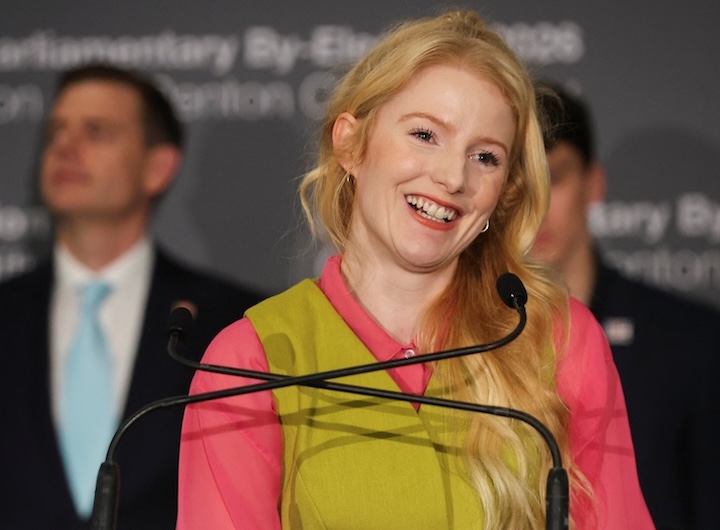
The Greens led by Hannah Spencer, a plumber and local councillor, did not simply edge ahead; they won on a message rooted in economic insecurity, housing pressures and local authenticity, coupled with targeted outreach to students and Muslim voters, particularly around Palestine. Critics accused them of indulging sectarian politics. But the result suggests their message resonated well beyond their traditional environmental base.
Reform, meanwhile, consolidated its position as the vehicle for culturally conservative and economically anxious voters who feel abandoned by Westminster. Its appeal is strongest in northern and post-industrial communities, where distrust of mainstream parties runs deep. Labour, squeezed from both flanks, found itself stranded in political no-man’s-land.
For months, Labour argued that stability after years of Conservative chaos amounted to meaningful change. But voters in Gorton and Denton delivered a different verdict: stability without visible transformation is insufficient. The by-election underscored broader forces reshaping British — and European — politics.
Most striking was the collapse of the “safe seat” firewall. Labour’s once five-figure majority evaporated, reflecting not a fleeting protest but a structural erosion of traditional loyalties. Voters are increasingly willing to experiment. Britain’s two-party dominance is giving way to a fragmented landscape in which governments can be punished from multiple directions at once.
The Greens have become the principal outlet for left-wing frustration with Labour’s cautious governing style. Their victory was driven less by abstract environmentalism than by anger over living standards and a perception that government restraint is out of step with social need. The party is repositioning itself around inequality as much as climate, alongside a more isolationist foreign policy stance, including withdrawing from Nato.
Reform’s surge confirms the populist right’s consolidation as an alternative to the Conservatives. Its message blends cultural anxiety over immigration with economic grievance and a belief that neither major party speaks for those left behind.
For Labour, the strategic dilemma is acute: shift left to reclaim Green-curious voters and risk haemorrhaging support to Reform, or double down on fiscal caution and alienate younger and poorer supporters. Starmer’s technocratic tone, effective in opposition, now risks sounding managerial rather than transformative. When voters are impatient for change, moderation can feel emotionally thin.
The Prime Minister’s difficulties predate the by-election. A string of policy U-turns dented his authority. He blocked rival Andy Burnham from contesting the seat, fuelling internal discontent. The controversy deepened with renewed scrutiny of his decision to appoint Peter Mandelson as ambassador to Washington despite revelations about Mandelson’s past links to the sexual predator and financier Jeffrey Epstein. Although calls for resignation faded in the absence of a clear successor, the episode reinforced perceptions of poor judgement.
The Prime Minister survives for now. But within Labour ranks, murmurs persist that it is a question not of if, but when. The looming May local elections are widely expected to bring further losses, intensifying pressure on Starmer’s leadership.
The reverberations extend beyond Britain. Across Europe, centre-left parties are being squeezed between Green or radical-left challengers on one side and populist-right movements on the other. In Germany, France and the Netherlands, fragmentation has replaced stability as the defining feature of electoral politics. Voters are increasingly sceptical of parties that present themselves as careful managers of constraint rather than agents of visible change.
The Gorton and Denton by-election is not a definitive verdict on Labour’s programme. But it is a warning shot. Stability alone no longer suffices. Voters are demanding tangible progress — and they are willing to look elsewhere to find it. The question for Labour is whether this tremor prompts adaptation, or marks the beginning of a deeper erosion of its authority.
 By: N. Peter Kramer