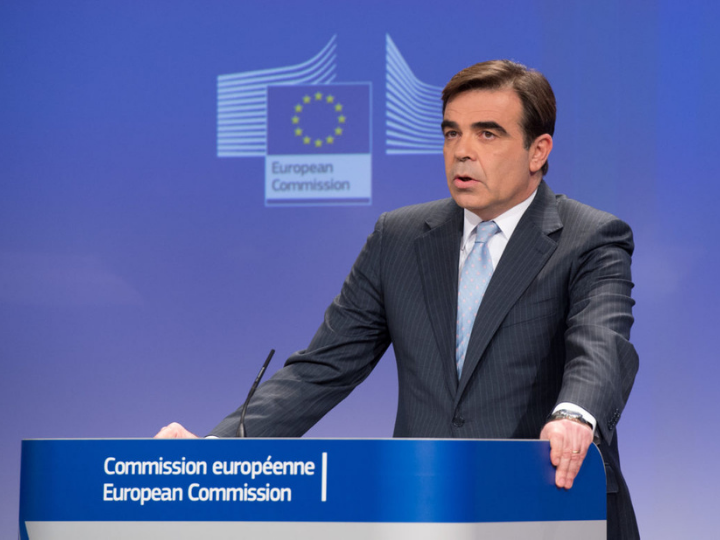
by Sarantis Michalopoulos
Once a seasoned Brussels insider, Margaritis Schinas, Greece’s newly appointed agriculture minister, has been called upon to resolve a Greek agricultural tragedy.
Former MEP (2007-09), vice-president of the European Commission (2019-24) and head of the Commission’s spokespersons’ service (2014-19), Schinas is back to take on arguably the most delicate ministerial post in Greece, after months of turmoil linked to alleged fraud in the distribution of EU agricultural subsidies.
Two weeks before his appointment, when asked in an interview with Euractiv whether he was considering entering Greek politics, Schinas replied: “I’m very happy with my current life. I took my life back. It is the first time this has happened after thirty-five years of frontline politics. I hope it lasts. I’m not sure it will.”
Yet developments in Greek politics shattered that calm, thrusting him into a role no one in Athens wanted: the agriculture ministry portfolio.
The crisis erupted after the European Public Prosecutor’s Office (EPPO) discovered that some subsidy applicants were claiming ownership of land they did not possess. Others declared farms or pasturelands far from their residences using forged addresses and leases.
Former agriculture minister Kostas Tsiaras resigned last Friday. On Tuesday, parliament lifted the immunity of another ten centre-right lawmakers, also allegedly implicated in the scandal, which has shaken Greek politics and tested Prime Minister Kyriakos Mitsotakis.
Schinas is now called upon to manage a sector in deep crisis of confidence in national institutions. In return, sources close to the government in Athens suggest he may be offered the chance to stand as a candidate lawmaker in northern Greece in next year’s national elections.
Until then, however, he has several hot potatoes to handle.
The unpaid farmers
Farmers fear that law-abiding producers are paying the price for their corrupt colleagues. Several farmers from northern Greece recently told Euractiv that, despite passing all audits, their payments have been blocked because the government refuses to recognise past oral land agreements – a common practice in Greece and other EU countries, such as Hungary, due to fragmented land and incomplete registries.
Even when farmers submitted official declarations from both landowners and the parties with whom land was exchanged, the government rejected them, arguing that the EU prosecutor does not accept such evidence.
Yet in a March interview with Euractiv, EPPO chief Laura Kövesi dismissed this argument, saying her office only handles fraud cases: “It is not our role to decide who receives subsidies, who is responsible for allocating them, or whether funds should be suspended.”
The embattled agency
Another headache for Schinas is the planned replacement of OPEKEPE – the agency responsible for distributing EU agricultural subsidies, and the epicentre of the scandal – with the Independent Authority for Public Revenue (AADE).
The transition has yet to be approved by the European Commission, and many obstacles remain. AADE is primarily a tax collection body, and its staff lack agricultural expertise. OPEKEPE officials have been forced to remain in the agency for at least three more years to preserve institutional know-how.
“Many want to leave following the scandal,” an OPEKEPE source told Euractiv, adding that finding skilled agriculture experts – both within the agency and the ministry – will be a major challenge for Schinas.
Greek reality and the new CAP
The same source noted that Schinas will simultaneously have to negotiate the new Common Agricultural Policy (CAP). Diplomatically, he is in a difficult position: asking for more EU funds for Greek farmers is complicated by the shadow of the fraud scandal.
Nevertheless, Schinas is renowned for his EU technocratic experience and is considered one of the architects of Europe’s migration pact. His Brussels contacts may help facilitate communications and rebuild trust between Brussels and Athens.
Still, it remains uncertain to what extent his technocratic background will help him navigate domestic political pressures. By his side, the agriculture vice-minister is Makarios Lazaridis, who, unlike Schinas, is firmly regarded as a politician within Mitsotakis’s inner circle and may cast a long shadow over him.
Schinas’s mission to combat agricultural fraud will be tough. But surviving Greek politics may prove even more challenging.
*Published first on Euractiv.com
 By: N. Peter Kramer