by Rajnish Singh, European Policy Centre
Brussels talks endlessly about “de‑risking”, but too often without a credible plan. This year’s EU–India Free Trade Agreement proved the bloc can still deliver major, strategic deals when it chooses to. The next logical step is clear: the EU must fast‑track a comprehensive trade agreement with ASEAN — a region whose economic weight and geopolitical relevance grows every year.
Yet despite the scale of the relationship, the EU and ASEAN still do not have a region‑to‑region Free Trade Agreement. Negotiations launched in 2007 were paused in 2009
In response, Brussels adopted a “two‑track” strategy: bilateral FTAs with individual ASEAN countries as stepping stones toward a future bloc‑to‑bloc agreement. Progress has been uneven. The EU–Singapore FTA entered into force in 2019, followed by the EU–Vietnam FTA in 2020. In July 2025, Brussels and Jakarta reached a political agreement on a Comprehensive Economic Partnership Agreement. Talks with Thailand, Malaysia and the Philippines have restarted. But the region‑to‑region deal remains elusive.
The absence of an overarching FTA is striking given the size of the economic relationship. According to the European Commission and Eurostat, EU–ASEAN goods trade reached between €274.9 billion in 2025, services trade exceeded €139.2 billion in 2024.
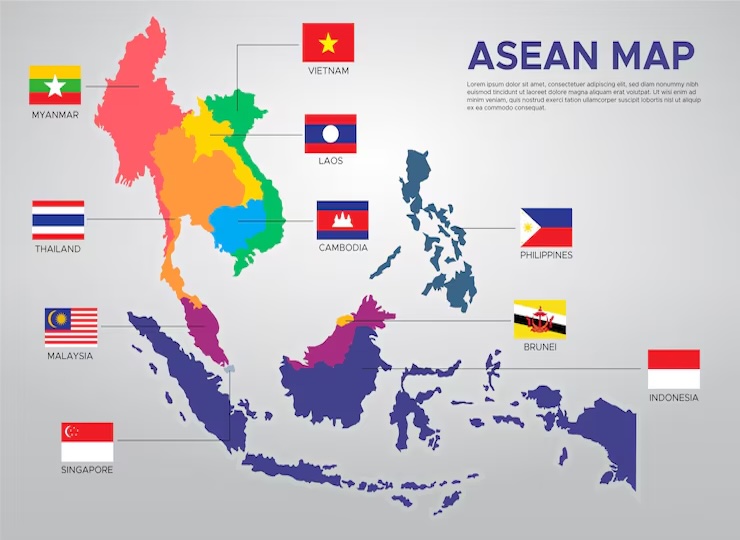
The EU is ASEAN’s third‑largest trading partner, after China and the United States, and the region’s third‑largest source of foreign direct investment, with annual inflows of roughly €18–€20 billion. ASEAN’s economic weight is rising fast. With between 660 and 686 million consumers and one of the world’s fastest‑growing digital markets, the bloc is becoming a central node in global supply chains. Five economies — Singapore, Vietnam, Malaysia, Thailand and Indonesia — dominate EU–ASEAN trade, accounting for nearly 90 percent of goods flows. In short, the EU already has a strong foundation. What it lacks is a strategy.
The EU–India deal is more than a diplomatic win; it is a blueprint. It combines tariff cuts with cooperation on standards, digital trade, sustainability and supply‑chain resilience. ASEAN governments have repeatedly signalled interest in these areas, most recently through the EU–ASEAN Joint Working Group on the Digital Economy and Green Transition. Brussels does not need to reinvent the wheel. It simply needs to apply the India template to a region already deeply integrated into European value chains.
Three major friction points continue to complicate negotiations. The first is the EU’s Green Deal. New environmental rules — including the EU Deforestation Regulation and the Carbon Border Adjustment Mechanism — are seen by ASEAN exporters as disguised protectionism. Palm oil and timber producers in Malaysia and Indonesia argue these measures unfairly penalise developing economies.
The second obstacle is structural. The EU is a highly integrated single market with top‑down regulatory authority. ASEAN, by contrast, operates through consensus, non‑interference and flexible implementation. Building a bloc‑to‑bloc framework that satisfies all ten members is extremely difficult.
The third challenge is political. The EU ties market access to human rights, labour standards and governance clauses. ASEAN’s political diversity — from democracies to military‑influenced systems — often clashes with Brussels’ values‑based approach. These challenges are real, but they are not insurmountable. The EU–Singapore and EU–Vietnam FTAs prove that ASEAN members can meet European standards when the incentives are clear.
If the EU is serious about de‑risking, ASEAN is indispensable. According to OECD Trade in Value Added data, Chinese intermediate goods account for more than a quarter of the foreign value added in ASEAN exports. ASEAN is not an alternative to China — it is a connector between China and global markets. And that is precisely why Europe needs it. During periods of China–US tension, ASEAN supply chains have helped stabilise global trade flows.
Strengthening ties with ASEAN would give Europe access to diversified production hubs, reduce exposure to single‑supplier risks and secure critical intermediate goods essential for European manufacturing. This is economic security through diversification, not isolation.
Europe can also learn from ASEAN’s China strategy. The region has never tried to “decouple” from China. Instead, it has pursued multi‑vector resilience: maintaining strong ties with Beijing while aggressively attracting investment from Europe, the United States, Japan and South Korea. It is pragmatic, non‑ideological and remarkably effective. Europe should take note.
The EU–India FTA has given Brussels renewed confidence. ASEAN is ready for deeper engagement. The economic case is clear. The geopolitical logic is stronger still. Europe cannot afford to wait. It should move — boldly, quickly and with a clear recognition that ASEAN is not just a market, but a strategic partner for a more secure European future.
 By: N. Peter Kramer