by
N. Peter Kramer
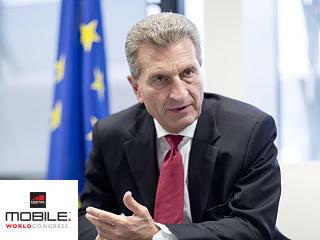
‘We Europeans have to do our job well’, he said, such as harmonising spectrum policy and modernising regulation. ‘We are lagging behind but we are coming back to the game’.
Oettinger promised another ‘white paper’ from the Commission and the 5G Industry Association, title 5G Empowering Vertical Industries. European automakers and telecom providers will work together to deliver connected and selfdriving cars across the EU’s 28 member states. Industry associations for these sectors will cooperate to ensure communications systems are upgraded to be fast and secure enough to support the technology for automated driving. A condition is that the technology across the EU has to be standardised.
The European Commission is forging ahead with a new plan to align the disparate and often contradictory digital interests in the 28 countries. The new European dream is the so-called digital-single market across the EU, a region with more than 60 languages and a population of more than 500 million. This digital single market involves a raft of new policies that would come into force by the end of the decade, if everything goes according to the plan. EU Commission’s Vice-President Ansip*, who is leading the digital campaign, said in Barcelona: ‘there are going to be no easy victories. It will be an uphill struggle’.
Mr Ansip, a former Estonian Prime Minister, is not exaggerating. He knows the obstacles given renewed anxiety about the global economy and the European problem of more than a million migrants from Syria, Afghanistan and Iraq. If the EU leaders, after deliberating a year long, can’t agree on who should be let across their national borders, some question how much time they will spend on ensuring, for instance, that Amazon purchases or iTunes subscriptions are delivered efficiently. eBay’s European head, Paul Todd, said: 'as soon as you go across a border it becomes complicated and costly’.
Another problem is that basic Internet skills along with other services like high-speed mobile networks vary drastically among European countries, as does understanding of e-commerce and general familiarity with the online world. In Sweden and Estonia for instance 85% of the population surfs the web each day; 75% bought goods online last year. Compare that with Bulgaria, Romania, Portugal, Spain and Italy, fast mobile connections don’t exist outside big cities; and high-speed broadband? Maybe they just started with rolling it out.
The European Commission says the EU needs a single digital market. The hope is that a unified digital marketplace would help to improve Europe’s moribund economy. The question is: how do you make that happen?
*Yes, the European Commission has 2 members working on the digital future of the block. In Barcelona it turned out that they have each an own vision on the subject…